


Page 545 - DSP Integrated Circuits
P. 545
530                                           Chapter 11 Processing Elements


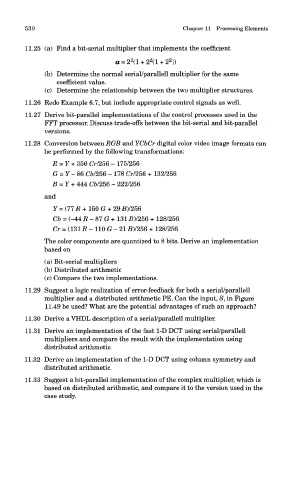
        11.25 (a) Find a bit-serial multiplier that implements the coefficient


              (b) Determine the normal serial/parallell multiplier for the same
                 coefficient value.
              (c) Determine the relationship between the two multiplier structures.

        11.26 Redo Example 6.7, but include appropriate control signals as well.
        11.27 Derive bit-parallel implementations of the control processes used in the
              FFT processor. Discuss trade-offs between the bit-serial and bit-parallel
              versions.
        11.28 Conversion between RGB and YCbCr digital color video image formats can
              be performed by the following transformations:
                R = Y + 350 Cr/256 - 175/256
                G = Y- 86 C6/256 - 178 Cr/256 + 132/256
                B = Y + 444 C6/256 - 222/256
              and
                Y = (77 R + 150 G + 29 £)/256
                Cb = (-44 R - 87 G + 131 B)/256 + 128/256
                Cr = (131R - 110 G - 21 B)/256 + 128/256
              The color components are quantized to 8 bits. Derive an implementation
              based on
              (a) Bit-serial multipliers
              (b) Distributed arithmetic
              (c) Compare the two implementations.
        11.29 Suggest a logic realization of error-feedback for both a serial/parallell
              multiplier and a distributed arithmetic PE. Can the input, S, in Figure
              11.49 be used? What are the potential advantages of such an approach?

        11.30 Derive a VHDL description of a serial/parallell multiplier.
        11.31 Derive an implementation of the fast 1-D DCT using serial/parallell
              multipliers and compare the result with the implementation using
              distributed arithmetic.
        11.32 Derive an implementation of the 1-D DCT using column symmetry and
              distributed arithmetic.

        11.33 Suggest a bit-parallel implementation of the complex multiplier, which is
              based on distributed arithmetic, and compare it to the version used in the
              case study.

