


Page 542 - DSP Integrated Circuits
P. 542
Problems                                                             527


                required in a bit-serial isomorphic implementation. W^ = 20 bits and
                a =0.375.
             (b) Determine the number of D flip-flops and bit-serial adders (subtracters)
                required to implement the multiplication using a simplified S/P
                multiplier.
             (c) Determine the maximal sampling frequency when the full-adders can be
                clocked at 400 MHz.
             (d) Sketch the attenuation for the filter.
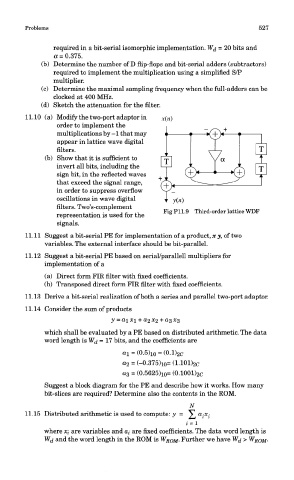
        11.10 (a) Modify the two-port adaptor in
                 order to implement the
                 multiplications by -1 that may
                 appear in lattice wave digital
                 filters.
              (b) Show that it is sufficient to
                 invert all bits, including the
                 sign bit, in the reflected waves
                 that exceed the signal range,
                 in order to suppress overflow
                 oscillations in wave digital
                 filters. Two's-complement
                                                 FigP11.9 Third-order lattice WDF
                 representation is used for the
                 signals.
        11.11 Suggest a bit-serial PE for implementation of a product, x y, of two
              variables. The external interface should be bit-parallel.
        11.12 Suggest a bit-serial PE based on serial/parallell multipliers for
              implementation of a

              (a) Direct form FIR filter with fixed coefficients.
              (b) Transposed direct form FIR filter with fixed coefficients.
        11.13 Derive a bit-serial realization of both a series and parallel two-port adaptor.

        11.14 Consider the sum of products


              which shall be evaluated by a PE based on distributed arithmetic. The data
              word length is Wj =17 bits, and the coefficients are


              Suggest a block diagram for the PE and describe how it works. How many
              bit-slices are required? Determine also the contents in the ROM.


        11.15 Distributed arithmetic is used to compute:

              where jc/ are variables and a; are fixed coefficients. The data word length is
              Wd and the word length in the ROM is WRQM- Further we have Wj > WRQM-

