


Page 537 - DSP Integrated Circuits
P. 537
522                                            Chapter 11 Processing Elements


        11.19.5 RAM Address PEs
        The address processors must compute the RAM addresses from the base index by
        conditional setting of the extended bits. This can be accomplished by the unit
        shown in Figure 11.57.

                                        taddress Register
              *1 1
                       ^ D    D     D    D  ~*  D ->  D  -> D  -*  D  ~*  D
                           -     -


                   Figure 11.57 Logic implementation of the address generation
            The e input is used for setting the extended bits. To save area we can share
        the switch in this address register with the switch in the base index generator.
        However, this sharing leads to a small modification of the partitioning of the
        address generation. The Stage PE can be implemented as a shift register with
        log2(M2) = 9 bits. In fact, we use N s instead of Stage. The input to the computation
        of the coefficients is p. The exponent p relates to k\ by


            Hence, p is equal to k\ shifted Stage-I steps to the right. This can be per-
        formed in a shift register. We need both p and its two's-complement value, which
        can be computed using a bit-serial subtractor.


        11.20 DCT PROCESSOR, Cont.

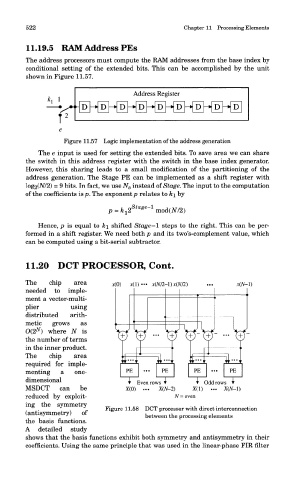
        The    chip   area                   x(N/2-\) x(N/2)
        needed to imple-
        ment a vector-multi-
        plier        using
        distributed  arith-
        metic   grows   as
        O(2^) where N is
        the number of terms
        in the inner product.                                T
        The    chip   area                                         I,,-,,
        required for imple-                             •<*'•••,
        menting   a   one-                                PE        PE
        dimensional                   T Even rows T          Odd rows
        MSDCT     can   be           X(0) ...   X(N-2)
        reduced by exploit-                         N = even
        ing the symmetry
                               Figure 11.58 DCT processor with direct interconnection
        (antisymmetry)  of                 between the processing elements
        the basis functions.
        A detailed study
        shows that the basis functions exhibit both symmetry and antisymmetry in their
        coefficients. Using the same principle that was used in the linear-phase FIR filter

