


Page 305 - Design of Reinforced Masonry Structures
P. 305
COLUMNS                          5.25

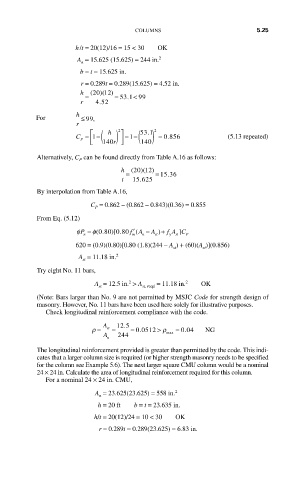
                     h/t = 20(12)/16 = 15 < 30    OK
                      A  = 15.625 (15.625) = 244 in. 2
                       n
                       b = t = 15.625 in.
                       r = 0.289t = 0.289(15.625) = 4.52 in.
                             12
                       h  (20 )( )
                        =       = 53 .1 < 99
                       r    . 452
                     h
           For         ≤ 99,
                      r
                                 2
                                 ⎤
                         ⎡  ( ) ⎥ ( )      2
                              h
                                       53 1 .
                     C = 1 −       =−       = 08566           (5.13 repeated)
                                    1
                                              .
                         ⎢
                       P  ⎣  140 r ⎦   140
           Alternatively, C  can be found directly from Table A.16 as follows:
                      P
                                       )( )
                                  h
                                   =  (20 12  = 15 .36
                                  t  15 .625
           By interpolation from Table A.16,
                         C  = 0.862 – (0.862 – 0.843)(0.36) = 0.855
                           P
           From Eq. (5.12)
                                     ′
                                     (
                      φP = φ(.080 )[.080  f A −  A +  f A C
                                            )
                                                 ]
                       n             m  n  st  y  st  P
                     620 = (0.9)(0.80)[0.80 (1.8)(244 – A ) + (60)(A )](0.856)
                                                        st
                                                st
                      A  = 11.18 in. 2
                       st
           Try eight No. 11 bars,
                                                   2
                                    2
                          A  = 12.5 in.  > A st, reqd  = 11.18 in.   OK
                            st
           (Note: Bars larger than No. 9 are not permitted by MSJC Code for strength design of
           masonry. However, No. 11 bars have been used here solely for illustrative purposes.
             Check longitudinal reinforcement compliance with the code.
                                  .
                          ρ =  A st  =  12 5  = 0 0512.  >  ρ max  = 0 04.     NG
                             A   244
                              n

           The longitudinal reinforcement provided is greater than permitted by the code. This indi-
           cates that a larger column size is required (or higher strength masonry needs to be specified
           for the column see Example 5.6). The next larger square CMU column would be a nominal
           24 × 24 in. Calculate the area of longitudinal reinforcement required for this column.
             For a nominal 24 × 24 in. CMU,
                           A  = 23.625(23.625) = 558 in. 2
                            n
                           h = 20 ft    b = t = 23.635 in.
                          h/t = 20(12)/24 = 10 < 30    OK
                            r = 0.289t = 0.289(23.625) = 6.83 in.

