


Page 448 - Design of Reinforced Masonry Structures
P. 448
7.10                      CHAPTER SEVEN


                                             Metal lath or wire screen
                                             over cores to support
                                             mortar or grout fill
                                              Control joint
                                              rake out and caulk


                                                      Embedment
                                                      ends in cores
                                                      filled with grout

                                           1-1/4" × 1/4" × 30" strap
                                           anchors with 3" right angle
                                           bends at each end, at 48" o.c.
                                           max. vertically
                                 Unbonded intersection

                                                    Shear
                                                    reinforcement
                                                    in horizontal
                                                    bond beams


                                                   Reinforcement
                                                   extends
                                                   through
                                                   intersection into
                                                   flanges
                                  Bonded intersection

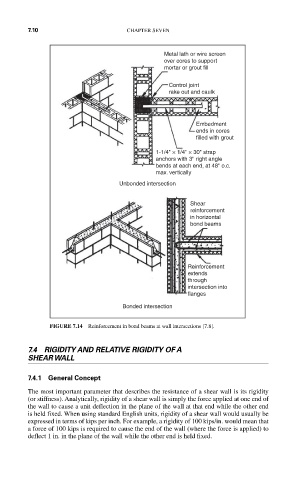
              FIGURE 7.14  Reinforcement in bond beams at wall intersections [7.8].


         7.4  RIGIDITY AND RELATIVE RIGIDITY OF A
         SHEAR WALL


         7.4.1 General Concept
         The most important parameter that describes the resistance of a shear wall is its rigidity
         (or stiffness). Analytically, rigidity of a shear wall is simply the force applied at one end of
         the wall to cause a unit deflection in the plane of the wall at that end while the other end
         is held fixed. When using standard English units, rigidity of a shear wall would usually be
         expressed in terms of kips per inch. For example, a rigidity of 100 kips/in. would mean that
         a force of 100 kips is required to cause the end of the wall (where the force is applied) to
         deflect 1 in. in the plane of the wall while the other end is held fixed.

