


Page 535 - Design of Reinforced Masonry Structures
P. 535
SHEAR WALLS                       7.97


                                                ae y
                              b
                                                        e mu
                                    c                  c
                                        NA
                                                         d
                      h               d
                             A s

                                                     ae y
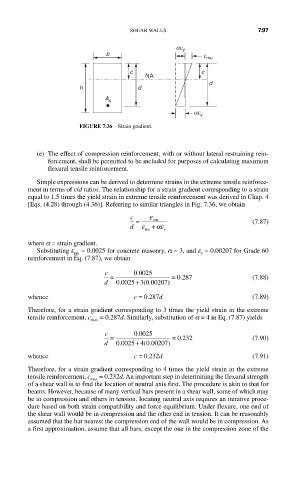
                      FIGURE 7.36  Strain gradient.


           (e)   The effect of compression reinforcement, with or without lateral restraining rein-
              forcement, shall be permitted to be included for purposes of calculating maximum
              flexural tensile reinforcement.

           Simple expressions can be derived to determine strains in the extreme tensile reinforce-
         ment in terms of c/d ratios. The relationship for a strain gradient corresponding to a strain
         equal to 1.5 times the yield strain in extreme tensile reinforcement was derived in Chap. 4
         [Eqs. (4.28) through (4.36)]. Referring to similar triangles in Fig. 7.36, we obtain

                                    c    ε
                                      =   mu                         (7.87)
                                    d  ε  +αε
                                        mu   y
         where a = strain gradient.
           Substituting e  = 0.0025 for concrete masonry, a = 3, and e  = 0.00207 for Grade 60
                     mu                                y
         reinforcement in Eq. (7.87), we obtain
                             c       0 0025
                                      .
                               =               = 0 287               (7.88)
                                                  .
                                        (
                                         .
                                 .
                             d  0 0025 + 3 0 00207)
         whence                      c = 0.287d                      (7.89)
         Therefore, for a strain gradient corresponding to 3 times the yield strain in the extreme
         tensile reinforcement, c max  = 0.287d. Similarly, substitution of a = 4 in Eq. (7.87) yields
                                      .
                             c       0 0025
                             d  =  0 0025 + 4 0 00207)  = 0 232      (7.90)
                                                  .
                                 .
                                        ( .

         whence                      c = 0.232d                      (7.91)
         Therefore, for a strain gradient corresponding to 4 times the yield strain in the extreme
         tensile reinforcement, c   = 0.232d. An important step in determining the flexural strength
                         max
         of a shear wall is to find the location of neutral axis first. The procedure is akin to that for
         beams. However, because of many vertical bars present in a shear wall, some of which may
         be in compression and others in tension, locating neutral axis requires an iterative proce-
         dure based on both strain compatibility and force equilibrium. Under flexure, one end of
         the shear wall would be in compression and the other end in tension. It can be reasonably
         assumed that the bar nearest the compression end of the wall would be in compression. As
         a first approximation, assume that all bars, except the one in the compression zone of the

