


Page 283 - Digital Analysis of Remotely Sensed Imagery
P. 283
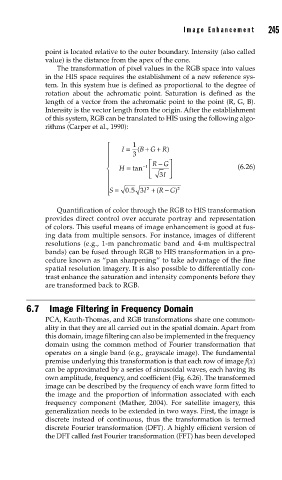
Image Enhancement       245

               point is located relative to the outer boundary. Intensity (also called
               value) is the distance from the apex of the cone.
                   The transformation of pixel values in the RGB space into values
               in the HIS space requires the establishment of a new reference sys-
               tem. In this system hue is defined as proportional to the degree of
               rotation about the achromatic point. Saturation is defined as the
               length of a vector from the achromatic point to the point (R, G, B).
               Intensity is the vector length from the origin. After the establishment
               of this system, RGB can be translated to HIS using the following algo-
               rithms (Carper et al., 1990):

                                ⎧      1
                                              +
                                           +
                                ⎪   I =  3 ( B G R)
                                ⎪
                                              −
                                ⎪           ⎡ RG⎤
                                ⎨   H = tan  −1 ⎢  ⎥                (6.26)
                                ⎪           ⎣  3 I ⎦
                                ⎪
                                ⎪ S = 05 3 I + ( R G) 2 2
                                                −
                                           2
                                      .
                                ⎩
                   Quantification of color through the RGB to HIS transformation
               provides direct control over accurate portray and representation
               of colors. This useful means of image enhancement is good at fus-
               ing data from multiple sensors. For instance, images of different
               resolutions (e.g., 1-m panchromatic band and 4-m multispectral
               bands) can be fused through RGB to HIS transformation in a pro-
               cedure known as “pan sharpening” to take advantage of the fine
               spatial resolution imagery. It is also possible to differentially con-
               trast enhance the saturation and intensity components before they
               are transformed back to RGB.


          6.7  Image Filtering in Frequency Domain
               PCA, Kauth-Thomas, and RGB transformations share one common-
               ality in that they are all carried out in the spatial domain. Apart from
               this domain, image filtering can also be implemented in the frequency
               domain using the common method of Fourier transformation that
               operates on a single band (e.g., grayscale image). The fundamental
               premise underlying this transformation is that each row of image f(x)
               can be approximated by a series of sinusoidal waves, each having its
               own amplitude, frequency, and coefficient (Fig. 6.26). The transformed
               image can be described by the frequency of each wave form fitted to
               the image and the proportion of information associated with each
               frequency component (Mather, 2004). For satellite imagery, this
               generalization needs to be extended in two ways. First, the image is
               discrete instead of continuous, thus the transformation is termed
               discrete Fourier transformation (DFT). A highly efficient version of
               the DFT called fast Fourier transformation (FFT) has been developed

