


Page 282 - Digital Analysis of Remotely Sensed Imagery
P. 282
244    Cha pte r  S i x

                   Absent from the above equation is TM , which that has a spatial
                                                   6
               resolution different from the remaining bands. This equation was
               established from Landsat TM4 satellite data. The transformation coef-
               ficients in the matrix would be slightly different if other TM satellite
               data were used.

               6.6.3 HIS Transformation
               A false-color image of three multispectral bands is visualized on a
               computer screen by projecting three spectral bands to the monitor
               using three guns of blue, green, and red lights. In this additive process,
               different proportions of these primary-color lights are mixed to pro-
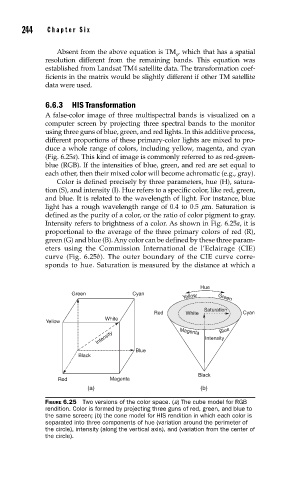
               duce a whole range of colors, including yellow, magenta, and cyan
               (Fig. 6.25a). This kind of image is commonly referred to as red-green-
               blue (RGB). If the intensities of blue, green, and red are set equal to
               each other, then their mixed color will become achromatic (e.g., gray).
                   Color is defined precisely by three parameters, hue (H), satura-
               tion (S), and intensity (I). Hue refers to a specific color, like red, green,
               and blue. It is related to the wavelength of light. For instance, blue
               light has a rough wavelength range of 0.4 to 0.5 mm. Saturation is
               defined as the purity of a color, or the ratio of color pigment to gray.
               Intensity refers to brightness of a color. As shown in Fig. 6.25a, it is
               proportional to the average of the three primary colors of red (R),
               green (G) and blue (B). Any color can be defined by these three param-
               eters using the Commission International de l’Eclairage (CIE)
               curve (Fig. 6.25b). The outer boundary of the CIE curve corre-
               sponds to hue. Saturation is measured by the distance at which a


                                                          Hue
                       Green           Cyan
                                                     Yellow    Green
                                                           Saturation
                                             Red      White           Cyan
                                White
                Yellow
                                                               Blue
                              Intensity                    Intensity
                                                    Magenta
                                        Blue
                        Black

                                                         Black
                   Red           Magenta
                           (a)                            (b)
               FIGURE 6.25  Two versions of the color space. (a) The cube model for RGB
               rendition. Color is formed by projecting three guns of red, green, and blue to
               the same screen; (b) the cone model for HIS rendition in which each color is
               separated into three components of hue (variation around the perimeter of
               the circle), intensity (along the vertical axis), and (variation from the center of
               the circle).

