


Page 280 - Digital Analysis of Remotely Sensed Imagery
P. 280
242    Cha pte r  S i x

               be redistributed. As indicated by Eq. (6.20), all the squared figures in a
               row sum to 1. So do all the squared figures in a column. The informa-
               tion content of a spectral band is split into many parts among the com-
               ponents. As shown in Table 6.6, the information content of band 1 is
               allocated mainly to components 2 and 4. On the other hand, the infor-
               mation content of the component 1 image originates mostly from band
               4, albeit negatively. This means that the radiometric appearance of the
               component 2 image resembles mostly that of band 4 in a reverse manner.
               Namely, a bright tone in the spectral band shows up as a dark tone in the
               component image, and vice versa. Similarly, the tonal appearance of com-
               ponent 2 resembles that of spectral band 1 most among all the bands.
               6.6.2 Tasseled Cap Transformation
               Also called the Kauth-Thomas (1976) transformation, the Tasseled Cap
               transformation was developed specifically for transforming the four
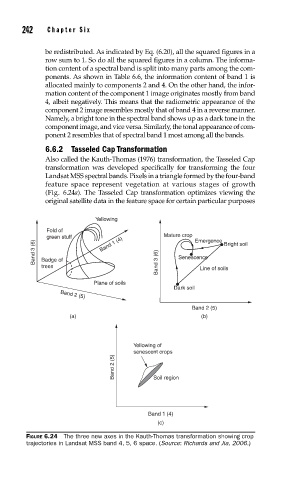
               Landsat MSS spectral bands. Pixels in a triangle formed by the four-band
               feature space represent vegetation at various stages of growth
               (Fig. 6.24a). The Tasseled Cap transformation optimizes viewing the
               original satellite data in the feature space for certain particular purposes

                             Yellowing
                Fold of
                green stuff                     Mature crop  Emergence
            3 (6)              Band 1 (4)                       Bright soil
            Band  Badge of                    3 (6)  Senescence
                                              Band        Line of soils
              trees
                             Plane of soils
                                                   Dark soil
                    Band 2 (5)
                                                        Band 2 (5)
                      (a)                                 (b)


                                        Yellowing of
                                        senescent crops
                                  Band 2 (5)  Soil region


                                            Band 1 (4)
                                              (c)
          FIGURE 6.24  The three new axes in the Kauth-Thomas transformation showing crop
          trajectories in Landsat MSS band 4, 5, 6 space. (Source: Richards and Jia, 2006.)

