


Page 136 - Academic Press Encyclopedia of Physical Science and Technology 3rd Organic Chemistry
P. 136
P1: FPP Revised Pages
 Encyclopedia of Physical Science and Technology  EN002C-85  May 17, 2001  20:35


               484                                                                                Catalysis, Homogeneous


                                                                 out with hundreds of C 2 chiral diphosphines and specific
                                                                 substrates only.

                             FIGURE 64 Disparlure.
                                                                 I. Terephthalic Acid
                                                                   1. Introduction
               alkenes are prochiral, or when the faces are enantiotopic).
                                                                 Terephthalic acid (1,4-benzenedicarboxylic acid) is used
               Three important reactions should be mentioned in this
                                                                 for the production of polyesters with aliphatic diols as the
               context the:
                                                                 comonomer. The polymer is a high-melting, crystalline
                                                                 material forming very strong fibers. It is the largest volume
               1. Katsuki-Sharpless epoxidation of allylic alcohols  synthetic fiber and the production of terephthalic acid is
               2. Sharpless asymmetric hydroxylation of alkenes with  the largest scale operated process based on a homogeneous
                  osmium tetroxide                               catalyst. More recently the packaging applications (PET,
               3. Jacobsen asymmetric epoxidation of alkenes     the recyclable copolymer with ethylene glycol) have also
                                                                 gained importance. Terephthalic acid is produced from
                 All three reactions find wide application in organic syn-  p-xylene by oxidation with oxygen. The reaction is car-
               thesis. Here we will only discuss the Sharpless epoxida-  ried out in acetic acid and the catalyst used is cobalt (or
               tion of allylic alcohols. This reaction finds industrial ap-  manganese) acetate and bromide. Phthalic anhydride is
               plication in Arco’s synthesis of glycidol, the epoxidation  made from naphthalene or o-xylene by air oxidation over
               product of allyl alcohol, and Upjohn’s synthesis of dispar-  a heterogeneous catalyst. The main application of phthalic
               lure (Fig. 64), a sex pheromone for the gypsy moth. The  anhydride is in the dialkylesters used as plasticizers (soft-
               synthesis of disparlure starts with a C 10 allyl alcohol in  eners) in PVC. The alcohols used are, for instance, 2-
               which the alcohol is replaced by the other carbon chain  ethylhexanol obtained from butanal, a hydroformylation
               after asymmetric epoxidation. Perhaps today the Jacobsen  product.
               method can be used directly on a suitable alkene, although
               the steric differences between both ends of the molecules
                                                                   2. The Chemistry
               are extremely small.
                                                                 The overall reaction reads as follows (Fig. 66):
                                                                   The reaction produces two moles of water per mole
                 2. Katsuki-Sharpless Asymmetric Epoxidation
                                                                 of terephthalic acid. The oxidation reaction is a radical
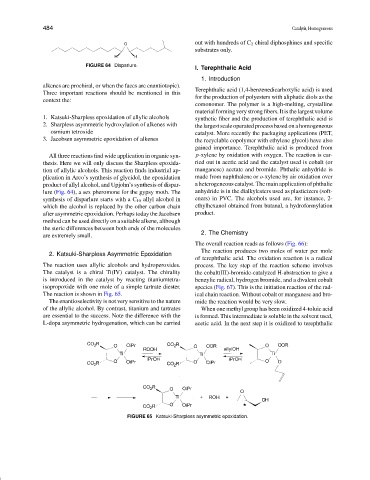
               The reaction uses allylic alcohols and hydroperoxides.  process. The key step of the reaction scheme involves
               The catalyst is a chiral Ti(IV) catalyst. The chirality  the cobalt(III)-bromide-catalyzed H-abstraction to give a
               is introduced in the catalyst by reacting titaniumtetra-  benzylic radical, hydrogen bromide, and a divalent cobalt
               isopropoxide with one mole of a simple tartrate diester.  species (Fig. 67). This is the initiation reaction of the rad-
               The reaction is shown in Fig. 65.                 ical chain reaction. Without cobalt or manganese and bro-
                 The enantioselectivity is not very sensitive to the nature  mide the reaction would be very slow.
               of the allylic alcohol. By contrast, titanium and tartrates  When one methyl group has been oxidized 4-toluic acid
               are essential to the success. Note the difference with the  is formed. This intermediate is soluble in the solvent used,
               L-dopa asymmetric hydrogenation, which can be carried  acetic acid. In the next step it is oxidized to terephthalic


                                           FIGURE 65 Katsuki-Sharpless asymmetric epoxidation.

