


Page 139 - Academic Press Encyclopedia of Physical Science and Technology 3rd Organic Chemistry
P. 139
P1: FPP Revised Pages
 Encyclopedia of Physical Science and Technology  EN002C-85  May 17, 2001  20:35


              Catalysis, Homogeneous                                                                      487


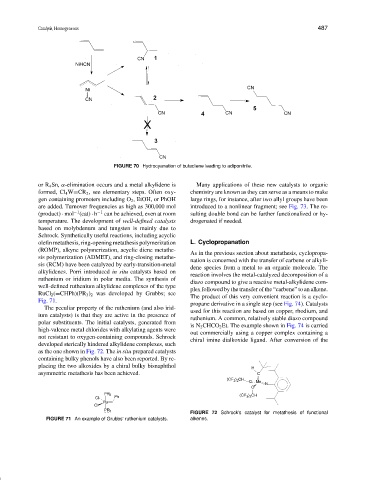
                                       FIGURE 70 Hydrocyanation of butadiene leading to adiponitrile.


              or R 4 Sn, α-elimination occurs and a metal alkylidene is  Many applications of these new catalysts to organic
              formed, Cl 4 W=CR 2 , see elementary steps. Often oxy-  chemistry are known as they can serve as a means to make
              gen containing promoters including O 2 , EtOH, or PhOH  large rings, for instance, after two allyl groups have been
              are added. Turnover frequencies as high as 300,000 mol  introduced to a nonlinear fragment; see Fig. 73. The re-
                         −1
              (product) · mol (cat) · h −1  can be achieved, even at room  sulting double bond can be further functionalized or hy-
              temperature. The development of well-defined catalysts  drogenated if needed.
              based on molybdenum and tungsten is mainly due to
              Schrock. Synthetically useful reactions, including acyclic
              olefin metathesis, ring-opening metathesis polymerization  L. Cyclopropanation
              (ROMP), alkyne polymerization, acyclic diene metathe-
                                                                As in the previous section about metathesis, cyclopropa-
              sis polymerization (ADMET), and ring-closing metathe-
                                                                nation is concerned with the transfer of carbene or alkyli-
              sis (RCM) have been catalyzed by early-transition-metal
                                                                dene species from a metal to an organic molecule. The
              alkylidenes. Porri introduced in situ catalysts based on
                                                                reaction involves the metal-catalyzed decomposition of a
              ruthenium or iridium in polar media. The synthesis of
                                                                diazo compound to give a reactive metal-alkylidene com-
              well-defined ruthenium alkylidene complexes of the type
                                                                plex followed by the transfer of the “carbene” to an alkene.
              RuCl 2 (=CHPh)(PR 3 ) 2 was  developed  by  Grubbs;  see
                                                                The product of this very convenient reaction is a cyclo-
              Fig. 71.
                                                                propane derivative in a single step (see Fig. 74). Catalysts
                The peculiar property of the ruthenium (and also irid-
                                                                used for this reaction are based on copper, rhodium, and
              ium catalysts) is that they are active in the presence of
                                                                ruthenium. A common, relatively stable diazo compound
              polar substituents. The initial catalysts, generated from
                                                                is N 2 CHCO 2 Et. The example shown in Fig. 74 is carried
              high-valence metal chlorides with alkylating agents were
                                                                out commercially using a copper complex containing a
              not resistant to oxygen-containing compounds. Schrock
                                                                chiral imine dialkoxide ligand. After conversion of the
              developed sterically hindered alkylidene complexes, such
              as the one shown in Fig. 72. The in situ prepared catalysts
              containing bulky phenols have also been reported. By re-
              placing the two alkoxides by a chiral bulky bisnaphthol
              asymmetric metathesis has been achieved.


                                                                FIGURE 72 Schrock’s catalyst for metathesis of functional
                FIGURE 71 An example of Grubbs’ ruthenium catalysts.  alkenes.

