


Page 138 - Academic Press Encyclopedia of Physical Science and Technology 3rd Organic Chemistry
P. 138
P1: FPP Revised Pages
 Encyclopedia of Physical Science and Technology  EN002C-85  May 17, 2001  20:35


               486                                                                                Catalysis, Homogeneous


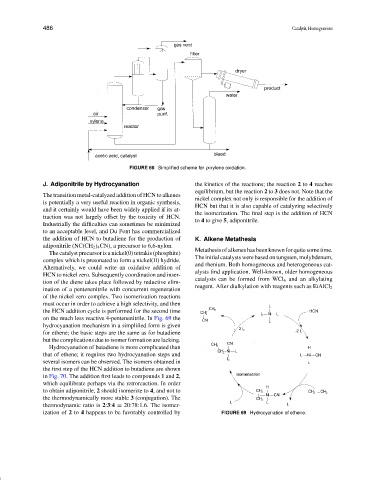
                                            FIGURE 68 Simplified scheme for p-xylene oxidation.

               J. Adiponitrile by Hydrocyanation                 the kinetics of the reactions; the reaction 2 to 4 reaches
                                                                 equilibrium, but the reaction 2 to 3 does not. Note that the
               The transition metal-catalyzed addition of HCN to alkenes
                                                                 nickel complex not only is responsible for the addition of
               is potentially a very useful reaction in organic synthesis,
                                                                 HCN but that it is also capable of catalyzing selectively
               and it certainly would have been widely applied if its at-
                                                                 the isomerization. The final step is the addition of HCN
               traction was not largely offset by the toxicity of HCN.
                                                                 to 4 to give 5, adiponitrile.
               Industrially the difficulties can sometimes be minimized
               to an acceptable level, and Du Pont has commercialized
               the addition of HCN to butadiene for the production of  K. Alkene Metathesis
               adiponitrile (NC(CH 2 ) 4 CN), a precursor to 6,6-nylon.
                                                                 Metathesis of alkenes has been known for quite some time.
                 The catalyst precursor is a nickel(0) tetrakis (phosphite)
                                                                 The initial catalysts were based on tungsten, molybdenum,
               complex which is protonated to form a nickel(II) hydride.
                                                                 and rhenium. Both homogeneous and heterogeneous cat-
               Alternatively, we could write an oxidative addition of
               HCN to nickel zero. Subsequently coordination and inser-  alysts find application. Well-known, older homogeneous
                                                                 catalysts can be formed from WCl 6 and an alkylating
               tion of the diene takes place followed by reductive elim-
               ination of a pentenenitrile with concurrent regeneration  reagent. After dialkylation with reagents such as EtAlCl 2
               of the nickel zero complex. Two isomerization reactions
               must occur in order to achieve a high selectivity, and then
               the HCN addition cycle is performed for the second time
               on the much less reactive 4-pentenenitrile. In Fig. 69 the
               hydrocyanation mechanism in a simplified form is given
               for ethene; the basic steps are the same as for butadiene
               but the complications due to isomer formation are lacking.
                 Hydrocyanation of butadiene is more complicated than
               that of ethene; it requires two hydrocyanation steps and
               several isomers can be observed. The isomers obtained in
               the first step of the HCN addition to butadiene are shown
               in Fig. 70. The addition first leads to compounds 1 and 2,
               which equilibrate perhaps via the retroreaction. In order
               to obtain adiponitrile, 2 should isomerize to 4, and not to
               the thermodynamically more stable 3 (conjugation). The
               thermodynamic ratio is 2:3:4 = 20:78:1.6. The isomer-
               ization of 2 to 4 happens to be favorably controlled by    FIGURE 69 Hydrocyanation of ethene.

