


Page 137 - Academic Press Encyclopedia of Physical Science and Technology 3rd Organic Chemistry
P. 137
P1: FPP Revised Pages
 Encyclopedia of Physical Science and Technology  EN002C-85  May 17, 2001  20:35


              Catalysis, Homogeneous                                                                      485


                                              FIGURE 66 Formation of terephthalic acid.


              acid, which is almost insoluble in acetic acid. The interme-  oration/condensation of acetic acid. This heat can be used
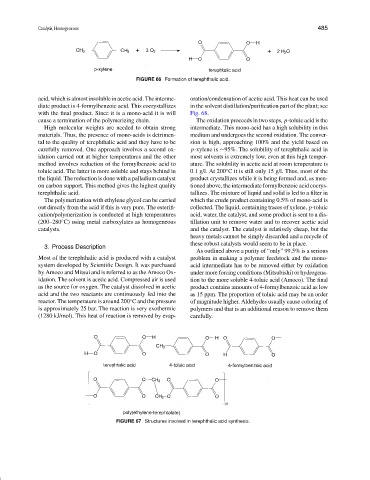
              diate product is 4-formylbenzoic acid. This cocrystallizes  in the solvent distillation/purification part of the plant; see
              with the final product. Since it is a mono-acid it is will  Fig. 68.
              cause a termination of the polymerizing chain.      The oxidation proceeds in two steps, p-toluic acid is the
                High molecular weights are needed to obtain strong  intermediate. This mono-acid has a high solubility in this
              materials. Thus, the presence of mono-acids is detrimen-  medium and undergoes the second oxidation. The conver-
              tal to the quality of terephthalic acid and they have to be  sion is high, approaching 100% and the yield based on
              carefully removed. One approach involves a second ox-  p-xylene is ∼95%. The solubility of terephthalic acid in
              idation carried out at higher temperatures and the other  most solvents is extremely low, even at this high temper-
              method involves reduction of the formylbenzoic acid to  ature. The solubility in acetic acid at room temperature is
              toluic acid. The latter in more soluble and stays behind in  0.1 g/l. At 200 C it is still only 15 g/l. Thus, most of the
                                                                            ◦
              the liquid. The reduction is done with a palladium catalyst  product crystallizes while it is being formed and, as men-
              on carbon support. This method gives the highest quality  tioned above, the intermediate formylbenzoic acid cocrys-
              terephthalic acid.                                tallizes. The mixture of liquid and solid is led to a filter in
                The polymerization with ethylene glycol can be carried  which the crude product containing 0.5% of mono-acid is
              out directly from the acid if this is very pure. The esterifi-  collected. The liquid, containing traces of xylene, p-toluic
              cation/polymerization is conducted at high temperatures  acid, water, the catalyst, and some product is sent to a dis-
              (200–280 C) using metal carboxylates as homogeneous  tillation unit to remove water and to recover acetic acid
                     ◦
              catalysts.                                        and the catalyst. The catalyst is relatively cheap, but the
                                                                heavy metals cannot be simply discarded and a recycle of
                                                                these robust catalysts would seem to be in place.
                3. Process Description
                                                                  As outlined above a purity of “only” 99.5% is a serious
              Most of the terephthalic acid is produced with a catalyst  problem in making a polymer feedstock and the mono-
              system developed by Scientific Design. It was purchased  acid intermediate has to be removed either by oxidation
              by Amoco and Mitsui and is referred to as the Amoco Ox-  under more forcing conditions (Mitsubishi) or hydrogena-
              idation. The solvent is acetic acid. Compressed air is used  tion to the more soluble 4-toluic acid (Amoco). The final
              as the source for oxygen. The catalyst dissolved in acetic  product contains amounts of 4-formylbenzoic acid as low
              acid and the two reactants are continuously fed into the  as 15 ppm. The proportion of toluic acid may be an order
              reactor. The temperature is around 200 C and the pressure  of magnitude higher. Aldehydes usually cause coloring of
                                            ◦
              is approximately 25 bar. The reaction is very exothermic  polymers and that is an additional reason to remove them
              (1280 kJ/mol). This heat of reaction is removed by evap-  carefully.


                                       FIGURE 67 Structures involved in terephthalic acid synthesis.

