


Page 154 - Academic Press Encyclopedia of Physical Science and Technology 3rd BioChemistry
P. 154
P1: GPAFinal Pages
 Encyclopedia of Physical Science and Technology  EN013D-616  July 27, 2001  12:5


               194                                                                                   Protein Structure


                TABLE I Properties of the Amino Acids            Lysine, arginine, and histidine can carry a positive charge.
                                                                 Ofthese,arginineisconstitutivelypositivelychargedsince
                                          Side chain
                   Amino acid               pK a    Occurrence   its pK a lies around 12.5. Lysine also plays an important
                                                                 role in coordinating negatively charged ligands; however,
                Aliphatic
                                                                 it functions as a nucleophile in some enzyme catalyzed
                  Glycine       Gly  G                7.2
                                                                 reactions. Histidine is perhaps the most common and ver-
                  Alanine       Ala  A                7.8
                                                                 satile catalytic residue in proteins. Its pK a of ∼6.0 allows
                  Valine        Val  V                6.6
                                                                 it to function both as a catalytic acid or base at physio-
                  Leucine       Leu  L                9.1
                                                                 logical pH depending on its local environment. Histidine
                  Isoleucine    Ile   I               5.3
                                                                 also has the ability to form covalent intermediates during
                  Proline       Pro  P                5.2
                                                                 catalysis such as phosphohistidine. In addition, it is often
                Aromatic
                                                                 a ligand for transition metal ions such as iron and zinc.
                  Phenylalanine  Phe  F               3.9
                  Tyrosine      Tyr  Y      10.5      3.2
                  Tryptophan    Trp  W                1.4        A. Post-Translational Modifications
                Polar uncharged
                                                                 Once synthesized and folded, many proteins undergo
                  Serine        Ser  S      ∼13       6.8
                                                                 post-translational modifications before they reach a func-
                  Threonine     Thr  T      ∼13       5.9
                                                                 tional state. Over 200 variant amino acid residues have
                  Cysteine      Cys  C      8.4       1.9
                                                                 been identified in proteins thus far. These changes are
                  Methionine    Met  M                2.2
                                                                 almost always achieved through an enzymatic pathway.
                  Asparagine    Asn  N                4.3
                                                                 The simplest changes include the formation of disulfide
                  Glutamine     Gln  Q                4.3
                                                                 bonds (discussed later) and proteolytic processing of the
                Positively charged
                                                                 polypeptide chain to yield a functional protein. Examples
                  Lysine        Lys  K      10.5      5.9
                                                                 of proteolytic processing include the removal of signal
                  Arginine      Arg  R      12.5      5.1
                                                                 peptides, the activation of zymogens to generate active
                  Histidine     His  H      6.0       2.3
                                                                 forms of many proteolytic enzymes, and the maturation of
                Negatively charged
                                                                 viral proteins. Additionally proteolytic processing occurs
                  Aspartate     Asp  D      3.9       5.3
                                                                 in the biosynthetic pathway of many hormones. Other sim-
                  Glutamate     Glu  E      4.1       6.3
                                                                 ple changes include the glycosylation of asparagine, ser-
                                                                 ine, threonine, and phosphorylation of serine and tyrosine.
                 The charged amino acids include aspartate, glutamate,  It is noteworthy that many post-translation modifica-
               lysine, arginine and histidine. As a group these amino  tions are associated with a sequence motif such that it
               acids are relatively abundant and are important for mak-  is frequently possible to identify potential sites directly
               ing proteins soluble. Thus, these residues are generally  from the amino acid sequence. This arises because most
               located on the surface of the protein unless they play a  post-translational modifications are the result of enzy-
               specific biological role. Aspartate and glutamate are neg-  matic pathways, which are usually highly specific. Thus
               atively charged amino acids. Both of these residues can  protein sequences inferred from DNA sequence are often
               function as general acids or bases in enzyme catalyzed  annotated with sites for post-translational modification.
               reactions. Likewise they are important metal ion ligands.  These sites should be viewed with caution since proof of
                                               COO     -                    COO     -
                                        +                                           +
                                   H N         C       H            H       C       NH
                                      3                                                  3

                                               CH                           CH
                                                    3                            3

                                       L-Alanine                        D-Alanine
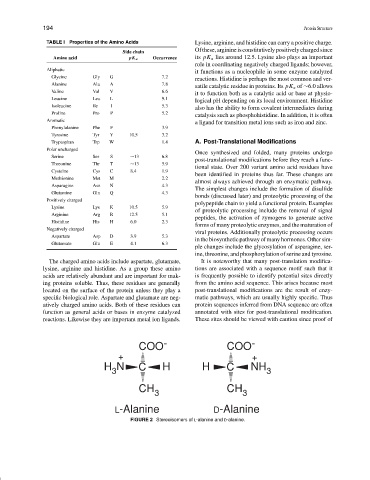
                                            FIGURE 2 Stereoisomers of L-alanine and D-alanine.

