


Page 434 - Engineering Electromagnetics, 8th Edition
P. 434
416                ENGINEERING ELECTROMAGNETICS

                                                                                  √
                                                                     9
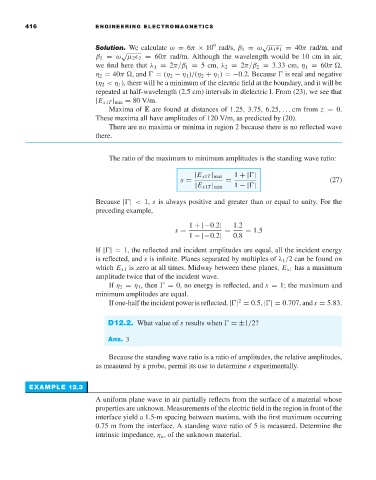
                                     Solution. We calculate ω = 6π × 10 rad/s, β 1 = ω µ 1   1 = 40π rad/m, and
                                            √
                                     β 2 = ω µ 2   2 = 60π rad/m. Although the wavelength would be 10 cm in air,
                                     we find here that λ 1 = 2π/β 1 = 5 cm, λ 2 = 2π/β 2 = 3.33 cm, η 1 = 60π
,
                                     η 2 = 40π
, and   = (η 2 − η 1 )/(η 2 + η 1 ) =−0.2. Because   is real and negative
                                     (η 2 <η 1 ), there will be a minimum of the electric field at the boundary, and it will be
                                     repeated at half-wavelength (2.5 cm) intervals in dielectric l. From (23), we see that
                                     |E x1T | min = 80 V/m.
                                        Maxima of E are found at distances of 1.25, 3.75, 6.25,... cm from z = 0.
                                     These maxima all have amplitudes of 120 V/m, as predicted by (20).
                                        There are no maxima or minima in region 2 because there is no reflected wave
                                     there.


                                        The ratio of the maximum to minimum amplitudes is the standing wave ratio:

                                                                |E x1T | max  1 +| |
                                                            s =         =                            (27)
                                                                |E x1T | min  1 −| |
                                     Because | | < 1, s is always positive and greater than or equal to unity. For the
                                     preceding example,

                                                              1 +|−0.2|   1.2
                                                          s =           =     = 1.5
                                                              1 −|−0.2|   0.8
                                     If | | = 1, the reflected and incident amplitudes are equal, all the incident energy
                                     is reflected, and s is infinite. Planes separated by multiples of λ 1 /2 can be found on
                                     which E x1 is zero at all times. Midway between these planes, E x1 has a maximum
                                     amplitude twice that of the incident wave.
                                        If η 2 = η 1 , then   = 0, no energy is reflected, and s = 1; the maximum and
                                     minimum amplitudes are equal.
                                                                            2
                                        If one-half the incident power is reflected, | | = 0.5, | |= 0.707, and s = 5.83.

                                        D12.2. What value of s results when   =±1/2?
                                        Ans. 3


                                        Because the standing wave ratio is a ratio of amplitudes, the relative amplitudes,
                                     as measured by a probe, permit its use to determine s experimentally.


                   EXAMPLE 12.3
                                     A uniform plane wave in air partially reflects from the surface of a material whose
                                     properties are unknown. Measurements of the electric field in the region in front of the
                                     interface yield a 1.5-m spacing between maxima, with the first maximum occurring
                                     0.75 m from the interface. A standing wave ratio of 5 is measured. Determine the
                                     intrinsic impedance, η u ,of the unknown material.

