


Page 433 - Engineering Electromagnetics, 8th Edition
P. 433
CHAPTER 12   Plane Wave Reflection and Dispersion      415

                         Further insights can be obtained by working with Eq. (19) and rewriting it in real
                     instantaneous form. The steps are identical to those taken in Chapter 10, Eqs. (81)
                     through (84). We find the total field in region 1 to be


                                E x1T (z, t) = (1 −| |)E  +  cos(ωt − β 1 z)
                                                   x10

                                                  traveling wave
                                           + 2| |E +  cos(β 1 z + φ/2) cos(ωt + φ/2)  (26)
                                                 x10

                                                         standing wave

                     The field expressed in Eq. (26) is the sum of a traveling wave of amplitude
                     (1 −| |)E  +  and a standing wave having amplitude 2| |E x10 . The portion of the in-
                                                                    +
                              x10
                     cident wave that reflects and back-propagates in region 1 interferes with an equivalent
                     portion of the incident wave to form a standing wave. The rest of the incident wave
                     (that does not interfere) is the traveling wave part of (26). The maximum amplitude
                     observed in region 1 is found where the amplitudes of the two terms in (26) add
                     directly to give (1 +| |)E  +  . The minimum amplitude is found where the standing
                                          x10
                     wave achieves a null, leaving only the traveling wave amplitude of (1−| |)E  +  . The
                                                                                  x10
                     fact that the two terms in (26) combine in this way with the proper phasing can be
                     confirmed by substituting z max and z min ,asgiven by (22) and (25).


                                                                                           EXAMPLE 12.2
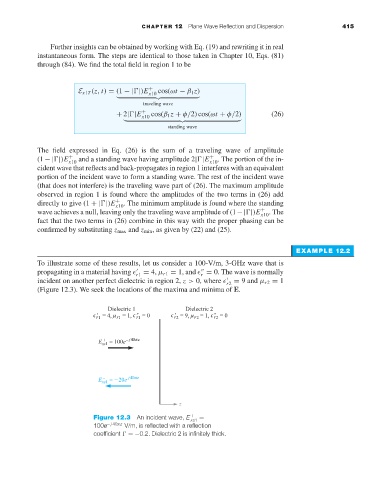
                     To illustrate some of these results, let us consider a 100-V/m, 3-GHz wave that is
                     propagating in a material having   r1  = 4, µ r1 = 1, and   = 0. The wave is normally


                                                                 r

                     incident on another perfect dielectric in region 2, z > 0, where   r2  = 9 and µ r2 = 1
                     (Figure 12.3). We seek the locations of the maxima and minima of E.


                                    Figure 12.3 An incident wave, E xs1  =
                                                               +
                                    100e − j 40πz  V/m, is reflected with a reflection
                                    coefficient   =−0.2. Dielectric 2 is infinitely thick.

