


Page 161 - Fluid Mechanics and Thermodynamics of Turbomachinery
P. 161
142 Fluid Mechanics, Thermodynamics of Turbomachinery
Stage loss relationships and efficiency
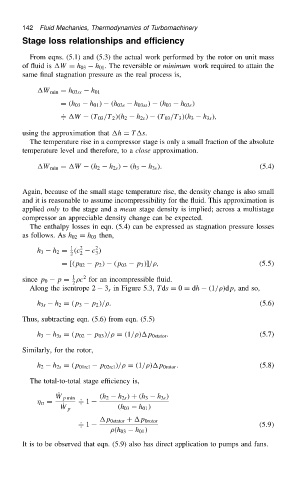
From eqns. (5.1) and (5.3) the actual work performed by the rotor on unit mass
of fluid is W D h 03 h 01 . The reversible or minimum work required to attain the
same final stagnation pressure as the real process is,
W min D h 03ss h 01
h 01 / h 03ss / h 03s /
D .h 03 .h 03s .h 03
+ W .T 03 /T 2 /.h 2 h 2s / .T 03 /T 3 /.h 3 h 3s /,
using the approximation that h D Ts.
The temperature rise in a compressor stage is only a small fraction of the absolute
temperature level and therefore, to a close approximation.
W min D W .h 2 h 2s / .h 3 h 3s /. (5.4)
Again, because of the small stage temperature rise, the density change is also small
and it is reasonable to assume incompressibility for the fluid. This approximation is
applied only to the stage and a mean stage density is implied; across a multistage
compressor an appreciable density change can be expected.
The enthalpy losses in eqn. (5.4) can be expressed as stagnation pressure losses
as follows. As h 02 D h 03 then,
2
1
h 2 D .c 2 c /
h 3 2 3
2
p 2 / p 3 /]/ , .5.5/
D [.p 02 .p 03
2
1
p D c for an incompressible fluid.
since p 0
2
Along the isentrope 2 3 s in Figure 5.3, Tds D 0 D dh .1/ /dp, and so,
h 3s h 2 D .p 3 p 2 // . (5.6)
Thus, subtracting eqn. (5.6) from eqn. (5.5)
p 03 // D .1/ /p 0stator . (5.7)
h 3 h 3s D .p 02
Similarly, for the rotor,
h 2 h 2s D .p 01rel p 02rel // D .1/ /p 0rotor . (5.8)
The total-to-total stage efficiency is,
P W p min h 3s /
.h 2 h 2s / C .h 3
tt D + 1
.h 03
P W p h 01 /
p 0stator C p 0rotor
+ 1 .5.9/
.h 03 h 01 /
It is to be observed that eqn. (5.9) also has direct application to pumps and fans.

