


Page 164 - Fluid Mechanics and Thermodynamics of Turbomachinery
P. 164
Axial-flow Compressors and Fans  145
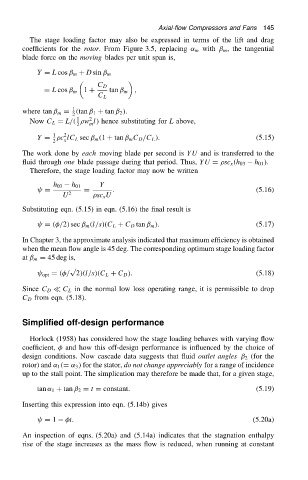
                            The stage loading factor may also be expressed in terms of the lift and drag
                          coefficients for the rotor. From Figure 3.5, replacing ˛ m with ˇ m , the tangential
                          blade force on the moving blades per unit span is,

                              Y D L cos ˇ m C D sin ˇ m

                                               C D
                                D L cos ˇ m 1 C   tan ˇ m ,
                                               C L
                                        1
                          where tan ˇ m D .tan ˇ 1 C tan ˇ 2 /.
                                        2
                                            2
                                         1
                            Now C L D L/.  w l/ hence substituting for L above,
                                         2  m
                                  1
                                     2
                              Y D  c lC L sec ˇ m .1 C tan ˇ m C D /C L /.                (5.15)
                                  2  x
                          The work done by each moving blade per second is YU and is transferred to the
                          fluid through one blade passage during that period. Thus, YU D  sc x .h 03  h 01 /.
                            Therefore, the stage loading factor may now be written
                                  h 03  h 01   Y
                                D          D       .                                      (5.16)
                                     U 2      sc x U
                          Substituting eqn. (5.15) in eqn. (5.16) the final result is

                                D . /2/ sec ˇ m .l/s/.C L C C D tan ˇ m /.                (5.17)
                          In Chapter 3, the approximate analysis indicated that maximum efficiency is obtained
                          when the mean flow angle is 45 deg. The corresponding optimum stage loading factor
                          at ˇ m D 45 deg is,
                                       p
                                opt D . / 2/.l/s/.C L C C D /.                            (5.18)

                          Since C D − C L in the normal low loss operating range, it is permissible to drop
                          C D from eqn. (5.18).


                          Simplified off-design performance


                            Horlock (1958) has considered how the stage loading behaves with varying flow
                          coefficient,   and how this off-design performance is influenced by the choice of
                          design conditions. Now cascade data suggests that fluid outlet angles ˇ 2 (for the
                          rotor) and ˛ 1 .D ˛ 3 / for the stator, do not change appreciably for a range of incidence
                          up to the stall point. The simplication may therefore be made that, for a given stage,

                              tan ˛ 1 C tan ˇ 2 D t D constant.                           (5.19)

                          Inserting this expression into eqn. (5.14b) gives
                                D 1    t.                                                (5.20a)

                          An inspection of eqns. (5.20a) and (5.14a) indicates that the stagnation enthalpy
                          rise of the stage increases as the mass flow is reduced, when running at constant

