


Page 219 - Fundamentals of Water Treatment Unit Processes : Physical, Chemical, and Biological
P. 219
174                            Fundamentals of Water Treatment Unit Processes: Physical, Chemical, and Biological


                  15                                                  C r is the mass concentration of the air bubbles that
                                              Conditions
                                             T =20°C                    must be generated to satisfy the demand by the
                                             d =40 μm                   particle number concentration in order to float the
                                              b
                                             ρ =1010 kg/m 3             particles; also termed, the air ‘‘released’’ by gas
                                              P
                                                                                           3
                                                                        precipitation (kg gas=m water)
                  10
                                                                  2. Bubble number concentration N b ,
                 v pb  (m/h)            B=10 bubble/particle                            F b
                                                                                         3
                                                                                      pd =6              (8:15)
                                                                                  N b ¼
                                                                                         b
                   5
                                                                    in which
                                                                          is  the  bubble  number  concentration  (#
                                                                      N b
                                  B=2 bubble/particle                            3
                                                                        bubbles=m water)
                     B =1 bubble/particle                             d b is the mean diameter of air bubbles (cm)
                   0
                    0     50   100   150   200   250   300
                                                                  After substituting (8.14) in (8.15),
                                    d p  (μm)
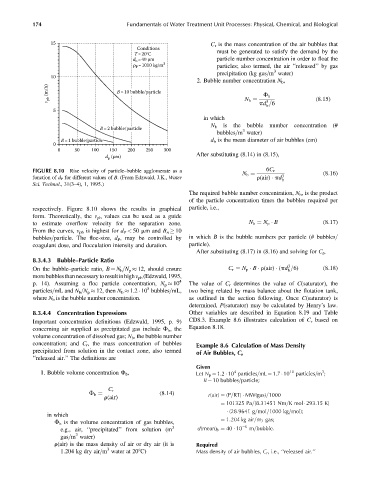
            FIGURE 8.10  Rise velocity of particle–bubble agglomerate as a               6C r              (8:16)
            function of d P for different values of B. (From Edzwald, J.K., Water  N b ¼  r(air)   pd 3
                                                                                              b
            Sci. Technol., 31(3–4), 1, 1995.)
                                                               The required bubble number concentration, N b , is the product
                                                               of the particle concentration times the bubbles required per
            respectively. Figure 8.10 shows the results in graphical  particle, i.e.,
            form. Theoretically, the v pb values can be used as a guide
            to estimate overflow velocity for the separation zone.                  N b ¼ N p   B           (8:17)
            From the curves, v pb is highest for d P < 50 mm and B n   10
            bubbles=particle. The floc-size, d P , may be controlled by  in which B is the bubble numbers per particle (# bubbles=
            coagulant dose, and flocculation intensity and duration.  particle).
                                                                  After substituting (8.17) in (8.16) and solving for C r ,
            8.3.4.3  Bubble–Particle Ratio
                                                                                                3
                                                                                                 =
            On the bubble–particle ratio, B ¼ N b =N p   12, should ensure  C r ¼ N p   B   r(air)   (pd 6)  (8:18)
                                                                                                b
            morebubblesthannecessarytoresultinhighv pb (Edzwald,1995,
            p. 14). Assuming a floc particle concentration, N p   10 4  The value of C r determines the value of C(saturator), the
                                                 5
            particles=mL and N b =N p   12, then N b   1.2   10 bubbles=mL,  two being related by mass balance about the flotation tank,
            where N b is the bubble number concentration.      as outlined in the section following. Once C(saturator) is
                                                               determined, P(saturator) may be calculated by Henry’s law.
            8.3.4.4  Concentration Expressions                 Other variables are described in Equation 8.19 and Table
            Important concentration definitions (Edzwald, 1995, p. 9)  CD8.3. Example 8.6 illustrates calculation of C r based on
            concerning air supplied as precipitated gas include F b , the  Equation 8.18.
            volume concentration of dissolved gas; N b , the bubble number
            concentration; and C r , the mass concentration of bubbles  Example 8.6 Calculation of Mass Density
            precipitated from solution in the contact zone, also termed
                                                                  of Air Bubbles, C r
            ‘‘released air.’’ The definitions are
                                                                  Given
              1. Bubble volume concentration F b ,                Let N p ¼ 1.2   10 particles=mL ¼ 1.7   10 10  particles=m ;
                                                                                                           3
                                                                              4
                                                                    B ¼ 10 bubbles=particle;
                                     C r
                                                      (8:14)
                              F b ¼                                   r(air) ¼ (P=RT)   MW(gas)=1000
                                   r(air)
                                                                          ¼ 101325 Pa=(8:31451 Nm=K mol   293:15 K)
                                                                              (28:9641 g=mol=1000 kg=mol);
                 in which
                                                                          ¼ 1:204 kg air=m 3 gas;
                   F b is the volume concentration of gas bubbles,                6
                     e.g., air, ‘‘precipitated’’ from solution (m 3  d(mean) b ¼ 40   10  m=bubble:
                          3
                     gas=m water)
                   r(air) is the mass density of air or dry air (it is  Required
                                    3
                     1.204 kg dry air=m water at 208C)            Mass density of air bubbles, C r , i.e., ‘‘released air.’’

