


Page 398 - High Power Laser Handbook
P. 398
366   So l i d - S t at e   La s e r s     The National Ignition Facility Laser    367


                   25
                      Top quad                     Bottom quad
                                       B314 B313  B312            B315 B316  B317
                   20
                                               B311                         B318
                  Output 1ω energy (kJ)  15


                   10


                    5

                    0
                     0.0  0.2  0.4  0.6  0.8  1.0  1.2  1.4 0  0.2  0.4  0.6  0.8  1.0  1.2  1.4
                             Injected energy (Joules)     Injected energy (Joules)
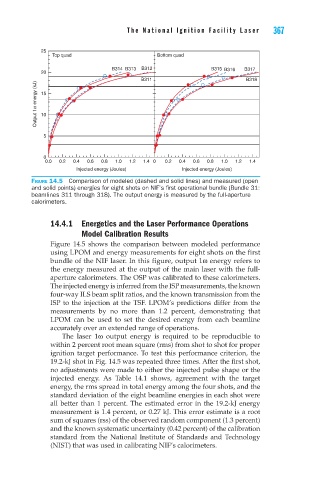
                 Figure 14.5  Comparison of modeled (dashed and solid lines) and measured (open
                 and solid points) energies for eight shots on NIF’s first operational bundle (Bundle 31:
                 beamlines 311 through 318). The output energy is measured by the full-aperture
                 calorimeters.

                      14.4.1   Energetics and the Laser Performance Operations
                               Model Calibration Results
                      Figure  14.5  shows  the  comparison  between  modeled  performance
                      using LPOM and energy measurements for eight shots on the first
                      bundle of the NIF laser. In this figure, output 1ω energy refers to
                      the energy measured at the output of the main laser with the full-
                      aperture calorimeters. The OSP was calibrated to these calorimeters.
                      The injected energy is inferred from the ISP measurements, the known
                      four-way ILS beam split ratios, and the known transmission from the
                      ISP to the injection at the TSF. LPOM’s predictions differ from the
                      measurements  by  no  more  than  1.2  percent,  demonstrating  that
                      LPOM  can  be  used  to  set  the  desired  energy  from  each  beamline
                      accurately over an extended range of operations.
                         The  laser  1ω  output  energy  is  required  to  be  reproducible  to
                      within 2 percent root mean square (rms) from shot to shot for proper
                      ignition target performance. To test this performance criterion, the
                      19.2-kJ shot in Fig. 14.5 was repeated three times. After the first shot,
                      no adjustments were made to either the injected pulse shape or the
                      injected  energy.  As  Table  14.1  shows,  agreement  with  the  target
                      energy, the rms spread in total energy among the four shots, and the
                      standard deviation of the eight beamline energies in each shot were
                      all better than 1 percent. The estimated error in the 19.2-kJ energy
                      measurement is 1.4 percent, or 0.27 kJ. This error estimate is a root
                      sum of squares (rss) of the observed random component (1.3 percent)
                      and the known systematic uncertainty (0.42 percent) of the calibration
                      standard from the National Institute of Standards and Technology
                      (NIST) that was used in calibrating NIF’s calorimeters.

