


Page 400 - High Power Laser Handbook
P. 400
368   So l i d - S t at e   La s e r s     The National Ignition Facility Laser    369


                                                      2
                                             Fluence (J/cm )
                      0      2      4      6      8     10     12     14     16
                    4.5
                        0.2 ns impulse
                    4.0
                                                            Design operating
                    3.5         1 ns  1.5 ns  2 ns             space
                  Power/beam (TW)  2.5  0.8 ns  shaped     shaped  shaped
                    3.0
                                                                 3.5 ns
                                                                  PQ
                                         1.0 MJ
                    2.0
                                                           1.8 MJ
                    1.5
                    1.0                                5 ns
                                                      9 ns shaped
                    0.5
                     0
                      0       2       4       6       8      10       12     14
                                            Energy/beam (kJ)
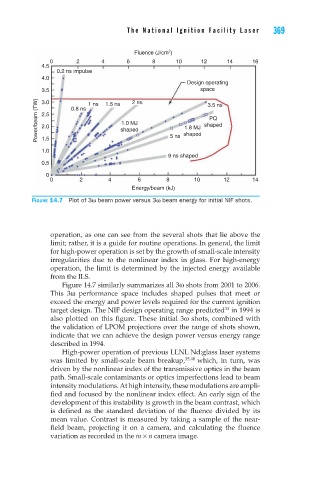
                 Figure 14.7  Plot of 3ω beam power versus 3ω beam energy for initial NIF shots.


                      operation, as one can see from the several shots that lie above the
                      limit; rather, it is a guide for routine operations. In general, the limit
                      for high-power operation is set by the growth of small-scale intensity
                      irregularities  due  to  the  nonlinear  index  in  glass.  For  high-energy
                      operation, the limit is determined by the injected energy available
                      from the ILS.
                         Figure 14.7 similarly summarizes all 3ω shots from 2001 to 2006.
                      This  3ω  performance  space  includes  shaped  pulses  that  meet  or
                      exceed the energy and power levels required for the current ignition
                                                                      33
                      target design. The NIF design operating range predicted  in 1994 is
                      also plotted on this figure. These initial 3ω shots, combined with
                      the validation of LPOM projections over the range of shots shown,
                      indicate that we can achieve the design power versus energy range
                      described in 1994.
                         High-power operation of previous LLNL Nd:glass laser systems
                      was  limited  by  small-scale  beam  breakup, 35,40   which,  in  turn,  was
                      driven by the nonlinear index of the transmissive optics in the beam
                      path. Small-scale contaminants or optics imperfections lead to beam
                      intensity modulations. At high intensity, these modulations are ampli-
                      fied and focused by the nonlinear index effect. An early sign of the
                      development of this instability is growth in the beam contrast, which
                      is  defined  as  the  standard  deviation  of  the  fluence  divided  by  its
                      mean value. Contrast is measured by taking a sample of the near-
                      field  beam,  projecting  it  on  a  camera,  and  calculating  the  fluence
                      variation as recorded in the m × n camera image.

