


Page 154 - How to write effective business English your guide to excellent professional communication by Fiona Talbot
P. 154
Paper is here to stay  143

           The message aligned with their television and online advertising
           campaign at that time. This level of cohesive communication as-
           sists the authenticity of their story and helps engagement in the
           narrative. It’s yet another example of effective business writing and
           it can be a joy to design!
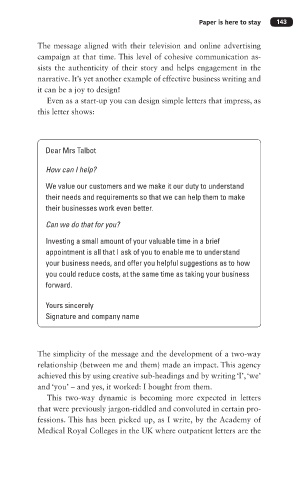
             Even as a start-up you can design simple letters that impress, as
           this letter shows:


             Dear Mrs Talbot

             How can I help?

             We value our customers and we make it our duty to understand
             their needs and requirements so that we can help them to make
             their businesses work even better.

             Can we do that for you?

             Investing a small amount of your valuable time in a brief
             appointment is all that I ask of you to enable me to understand
             your business needs, and offer you helpful suggestions as to how
             you could reduce costs, at the same time as taking your business
             forward.

             Yours sincerely
             Signature and company name


           The simplicity of the message and the development of a two-way
           relationship (between me and them) made an impact. This agency
           achieved this by using creative sub-headings and by writing ‘I’, ‘we’
           and ‘you’ – and yes, it worked: I bought from them.
             This two-way dynamic is becoming more expected in letters
           that were previously jargon-riddled and convoluted in certain pro-
           fessions. This has been picked up, as I write, by the Academy of
           Medical Royal Colleges in the UK where outpatient letters are the

