


Page 129 - Integrated Wireless Propagation Models
P. 129
M a c r o c e  I   P r e d i c t i o n  M o d e I s - P a r t  2 :  P o i n t - t o - P o i n t  M o d e I s   107
                                  I
               3.1.2.2  Frequency-Offset Adjustment
                                                                                  .
               Frequency offset adjustment is the second component of the model shown in Eq. (3 1 . 2.1).
               The reference frequency for the lee single breakpoint model is 850 MHz, and the model
               is valid within the frequency range of 150 to 2400 MHz.
                  When the center frequency used in the prediction is different from the reference
               frequency, the single breakpoint model calculates a frequency-offset adjustment (A1) in
                    .
               Eq. (3 1 . 2.1), which is given in dB. The algorithm for this adjustment depends on the
               following two factors:
                    1. The frequency range that includes the specified center frequency, such as 150 to
                      450 MHz, 451 to 850 MHz, and 851 to 2400 MHz, are defined for the adjustment.
                    2. Environment selection can be specified per sector. The Lee model can support
                      many environment types, such as dense urban, urban, commercial suburban,
                      residential suburban, cluttered rural, open rural, deciduous forest, water, and
                      evergreen forest.

                  For purposes of the frequency-offset adjustment, the Lee model categorizes the
               environment types into two classes, as follows:

                    1. Urban, which includes dense urban and urban
                    2. Non urban, which includes commercial suburban, residential suburban, cluttered
                      rural, open rural, deciduous forest, and evergreen forest

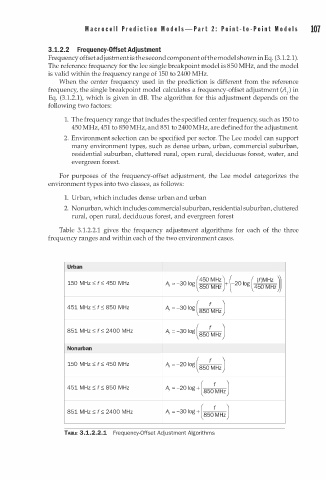
                  Table 3.1.2.2.1 gives the frequency adjustment algorithms for each of the three
               frequency ranges and within each of the two environment cases.


                     Urban
                                                          (  450 M (  (  (f)MHz  J
                                                                  +  -20 log
                     150  MHz :o; f :o;  450  M  H z   A = -30 log   850  M  H z  J   450  M  H z  J
                                                                H
                                                                 z
                                                              f
                     451 MHz :o; f :o; 850 M  H z   A = -30 log  l850 M  H z J

                                                              f
                     851 MHz :o; f :o; 2400 MHz   Ar = -30 log   H z J
                                                          l850 M
                                                I
                     Non urban
                                                              f
                     150  MHz :o; f :o; 450 M  H z   Ar = -20 log   H z J
                                                          l850 M
                                                               f
                     451 MHz :o; f :o; 850 M  H z   A = -20 log +  l850 M  H z J

                                                               f
                     851 MHz :o; f :o; 2400 MHz   A = -30 log +  l850 M  H z J
                                                I
                    TABLE 3.1.2.2.1  Frequency-Offset Adjustment Algorithms

