


Page 334 - Intelligent Digital Oil And Gas Fields
P. 334
278                                       Intelligent Digital Oil and Gas Fields


          decisions are made for ICV control). The main difference between smart and
          traditional IOR/EOR processes is that smart EOR uses:
          •  Massive subsurface (fiber optic or seismic) data streaming to monitor the
             frontal advance of injected fluids (water or steam).
          •  ICVs to control the well at down-hole condition, which allows better
             oil-sweep efficiency by focusing water, steam, or gas in the upswept/
             bypassed reservoir segments.
          •  Coupled surface, wellbore, and 3D reservoir models in simulators to
             generate scenarios to prevent early water, steam, or gas breakthrough
             to the producer wells.

          7.8.1 WAG Injection Process

          The WAG process is designed to improve sweep efficiency in order to reduce
          residual oil saturation after conventional water or gas injection and to control
          early water or gas breakthrough to producer wells. Depending on the fluid and
          rock types, viscosity, and wettability, water is injected into the reservoir for
          2–6months, followed by gas, and the cycle is repeated. Simultaneous water
          and gas (SWAG) injection is a variation where water and gas are injected
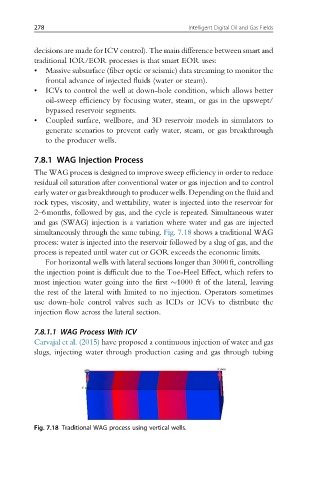
          simultaneously through the same tubing. Fig. 7.18 shows a traditional WAG
          process: water is injected into the reservoir followed by a slug of gas, and the
          process is repeated until water cut or GOR exceeds the economic limits.
             For horizontal wells with lateral sections longer than 3000ft, controlling
          the injection point is difficult due to the Toe-Heel Effect, which refers to
          most injection water going into the first  1000 ft of the lateral, leaving
          the rest of the lateral with limited to no injection. Operators sometimes
          use down-hole control valves such as ICDs or ICVs to distribute the
          injection flow across the lateral section.


          7.8.1.1 WAG Process With ICV
          Carvajal et al. (2015) have proposed a continuous injection of water and gas
          slugs, injecting water through production casing and gas through tubing


          Fig. 7.18 Traditional WAG process using vertical wells.

