


Page 339 - Intelligent Digital Oil And Gas Fields
P. 339
Smart Wells and Techniques for Reservoir Monitoring          283


                                     ICV1
                   Seismic                     ICV2   ICV3
                   thermal                                     ICV4


                                                                       230
                                                                       210
                                                                            Temperature (∞C)
                                                                       190
                    DTS
                                                                       170

                                                                       150
                       0                                               130
                               1000                                  150
                                         2000              50   100
                                                       0     Time, day
                               Well distance, ft
                         Zone A   Zone B  Zone C  Zone D
                Injectivity
               data x ICV          0.18          0.25
               (ton/d/kPa)
                           0.6
                                           0.8
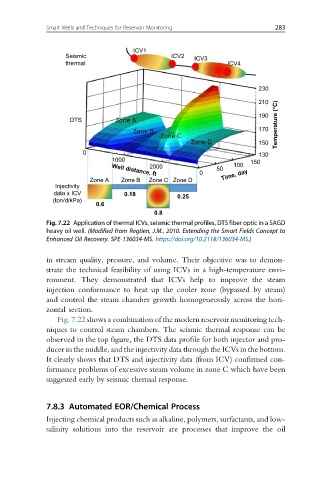
              Fig. 7.22 Application of thermal ICVs, seismic thermal profiles, DTS fiber optic in a SAGD
              heavy oil well. (Modified from Regtien, J.M., 2010. Extending the Smart Fields Concept to
              Enhanced Oil Recovery. SPE-136034-MS. https://doi.org/10.2118/136034-MS.)

              in stream quality, pressure, and volume. Their objective was to demon-
              strate the technical feasibility of using ICVs in a high-temperature envi-
              ronment. They demonstrated that ICVs help to improve the steam
              injection conformance to heat up the cooler zone (bypassed by steam)
              and control the steam chamber growth homogeneously across the hori-
              zontal section.
                 Fig. 7.22 shows a combination of the modern reservoir monitoring tech-
              niques to control steam chambers. The seismic thermal response can be
              observed in the top figure, the DTS data profile for both injector and pro-
              ducer in the middle, and the injectivity data through the ICVs in the bottom.
              It clearly shows that DTS and injectivity data (from ICV) confirmed con-
              formance problems of excessive steam volume in zone C which have been
              suggested early by seismic thermal response.


              7.8.3 Automated EOR/Chemical Process
              Injecting chemical products such as alkaline, polymers, surfactants, and low-
              salinity solutions into the reservoir are processes that improve the oil

