


Page 341 - Intelligent Digital Oil And Gas Fields
P. 341
Smart Wells and Techniques for Reservoir Monitoring          285


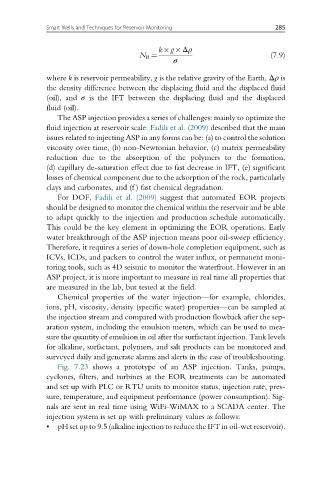
                                            k g  Δρ
                                       N B ¼                              (7.9)
                                                σ

              where k is reservoir permeability, g is the relative gravity of the Earth, Δρ is
              the density difference between the displacing fluid and the displaced fluid
              (oil), and σ is the IFT between the displacing fluid and the displaced
              fluid (oil).
                 The ASP injection provides a series of challenges: mainly to optimize the
              fluid injection at reservoir scale. Fadili et al. (2009) described that the main
              issues related to injecting ASP in any forms can be: (a) to control the solution
              viscosity over time, (b) non-Newtonian behavior, (c) matrix permeability
              reduction due to the absorption of the polymers to the formation,
              (d) capillary de-saturation effect due to fast decrease in IFT, (e) significant
              losses of chemical component due to the adsorption of the rock, particularly
              clays and carbonates, and (f ) fast chemical degradation.
                 For DOF, Fadili et al. (2009) suggest that automated EOR projects
              should be designed to monitor the chemical within the reservoir and be able
              to adapt quickly to the injection and production schedule automatically.
              This could be the key element in optimizing the EOR operations. Early
              water breakthrough of the ASP injection means poor oil-sweep efficiency.
              Therefore, it requires a series of down-hole completion equipment, such as
              ICVs, ICDs, and packers to control the water influx, or permanent moni-
              toring tools, such as 4D seismic to monitor the waterfront. However in an
              ASP project, it is more important to measure in real time all properties that
              are measured in the lab, but tested at the field.
                 Chemical properties of the water injection—for example, chlorides,
              ions, pH, viscosity, density (specific water) properties—can be sampled at
              the injection stream and compared with production flowback after the sep-
              aration system, including the emulsion meters, which can be used to mea-
              sure the quantity of emulsion in oil after the surfactant injection. Tank levels
              for alkaline, surfactant, polymers, and salt products can be monitored and
              surveyed daily and generate alarms and alerts in the case of troubleshooting.
                 Fig. 7.23 shows a prototype of an ASP injection. Tanks, pumps,
              cyclones, filters, and turbines at the EOR treatments can be automated
              and set up with PLC or RTU units to monitor status, injection rate, pres-
              sure, temperature, and equipment performance (power consumption). Sig-
              nals are sent in real time using WiFi-WiMAX to a SCADA center. The
              injection system is set up with preliminary values as follows:
              •  pH set up to 9.5 (alkaline injection to reduce the IFT in oil-wet reservoir).

