


Page 338 - Intelligent Digital Oil And Gas Fields
P. 338
282                                       Intelligent Digital Oil and Gas Fields


              1.0
              0.9
              0.8
             Water cut, fraction  0.6
              0.7

              0.5
              0.4
                              Water injection
              0.3
                                             WAG traditional
              0.2
              0.1
                                          WAGCV        Gas injection
                0
                01/01     09/03     06/06     03/09     12/11      09/14
                WCUT WAG-6×6    WCUT WAGCV      WCUT inj water  WCUT inj gas
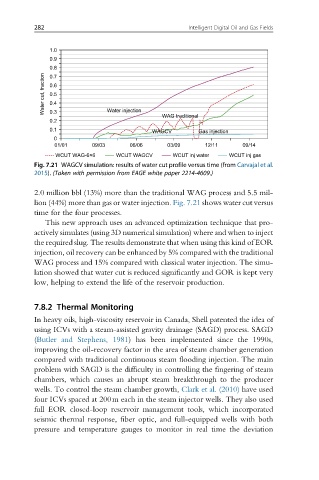
          Fig. 7.21 WAGCV simulation: results of water cut profile versus time (from Carvajal et al.
          2015). (Taken with permission from EAGE white paper 2214-4609.)

          2.0 million bbl (13%) more than the traditional WAG process and 5.5 mil-
          lion (44%) more than gas or water injection. Fig. 7.21 shows water cut versus
          time for the four processes.
             This new approach uses an advanced optimization technique that pro-
          actively simulates (using 3D numerical simulation) where and when to inject
          the required slug. The results demonstrate that when using this kind of EOR
          injection, oil recovery can be enhanced by 5% compared with the traditional
          WAG process and 15% compared with classical water injection. The simu-
          lation showed that water cut is reduced significantly and GOR is kept very
          low, helping to extend the life of the reservoir production.


          7.8.2 Thermal Monitoring
          In heavy oils, high-viscosity reservoir in Canada, Shell patented the idea of
          using ICVs with a steam-assisted gravity drainage (SAGD) process. SAGD
          (Butler and Stephens, 1981) has been implemented since the 1990s,
          improving the oil-recovery factor in the area of steam chamber generation
          compared with traditional continuous steam flooding injection. The main
          problem with SAGD is the difficulty in controlling the fingering of steam
          chambers, which causes an abrupt steam breakthrough to the producer
          wells. To control the steam chamber growth, Clark et al. (2010) have used
          four ICVs spaced at 200m each in the steam injector wells. They also used
          full EOR closed-loop reservoir management tools, which incorporated
          seismic thermal response, fiber optic, and full-equipped wells with both
          pressure and temperature gauges to monitor in real time the deviation

