


Page 340 - Intelligent Digital Oil And Gas Fields
P. 340
284                                       Intelligent Digital Oil and Gas Fields


          recovery reserves extraction by altering reservoir wettability, oil displace-
          ment mechanism, and residual oil saturation. However, chemical processes
          have had technical and economic challenges to widespread utilization. By
          implementing automation (DOF) principles, chemical EOR should gain
          efficacy as described in this section. By definition, the alkaline is a base
          (i.e., soap) that easily dissolves in water, and the solution base has a pH
          greater than 7.0. In the oil industry, the alkaline solution has been used
          to reduce the interfacial tension (IFT) of the remaining oil in situ, altering
          the original rock wettability and generating a reduction in the residual oil
          saturation (S orw ) after the primary water injection. Polymers are a large chain
          of molecules (synthetic or natural) that if injected with the water injection
          process can increase both the viscosity and the density of the water. The
          polymers are used to reduce the water mobility (ρ w /μ w ) in the formation
          and therefore generate a uniform sweep efficiency displacing oil. Surfactants
          (also called micelle) are organic compounds that reduce the IFT between
          different fluids (oil-water); surfactants are used as emulsions or foam agents
          to absorb the oil phase and generate miscible displacement (one fluid)
          between oil and water. These three types of chemical injection can also
          be mixed, designated as ASP (alkaline, surfactant, and polymers injection).
          The sequence of injection, slug size, total volume, chemical concentration,
          brine concentration, and injection rate depend on reservoir property distri-
          butions across the field.
             The chemical injection strongly depends on dominant forces governing
          the reservoir; these are viscous, gravity, and capillary forces. The reduction
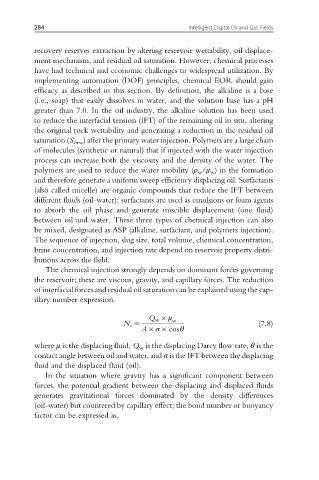
          of interfacial forces and residual oil saturation can be explained using the cap-
          illary number expression.

                                         Q w  μ
                                  N c ¼         w                      (7.8)
                                       A σ   cosθ

          where μ is the displacing fluid, Q w is the displacing Darcy flow rate, θ is the
          contact angle between oil and water, and σ is the IFT between the displacing
          fluid and the displaced fluid (oil).
             In the situation where gravity has a significant component between
          forces, the potential gradient between the displacing and displaced fluids
          generates gravitational forces dominated by the density differences
          (oil-water) but countered by capillary effect; the bond number or buoyancy
          factor can be expressed as.

