


Page 336 - Intelligent Digital Oil And Gas Fields
P. 336
280                                       Intelligent Digital Oil and Gas Fields


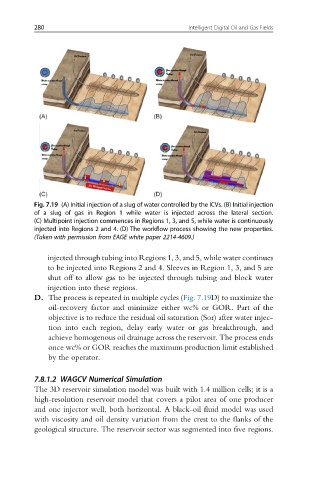
          Fig. 7.19 (A) Initial injection of a slug of water controlled by the ICVs. (B) Initial injection
          of a slug of gas in Region 1 while water is injected across the lateral section.
          (C) Multipoint injection commences in Regions 1, 3, and 5, while water is continuously
          injected into Regions 2 and 4. (D) The workflow process showing the new properties.
          (Taken with permission from EAGE white paper 2214-4609.)

              injected through tubing into Regions 1, 3, and 5, while water continues
              to be injected into Regions 2 and 4. Sleeves in Region 1, 3, and 5 are
              shut off to allow gas to be injected through tubing and block water
              injection into these regions.
          D. The process is repeated in multiple cycles (Fig. 7.19D) to maximize the
              oil-recovery factor and minimize either wc% or GOR. Part of the
              objective is to reduce the residual oil saturation (Sor) after water injec-
              tion into each region, delay early water or gas breakthrough, and
              achieve homogenous oil drainage across the reservoir. The process ends
              once wc% or GOR reaches the maximum production limit established
              by the operator.


          7.8.1.2 WAGCV Numerical Simulation
          The 3D reservoir simulation model was built with 1.4 million cells; it is a
          high-resolution reservoir model that covers a pilot area of one producer
          and one injector well, both horizontal. A black-oil fluid model was used
          with viscosity and oil density variation from the crest to the flanks of the
          geological structure. The reservoir sector was segmented into five regions.

