


Page 378 - Intelligent Digital Oil And Gas Fields
P. 378
Transitioning to Effective DOF Enabled by Collaboration and Management of Change  317


              management making assignments (Fig. 8.12). Teams go through a process of
              training, facilitation, and experience that transforms the way they work and a
              resultant high achievement. Fig. 8.12 presented a model of how teams pro-
              gress from Tuckman and Jensen (1997). Gilman and Kuhn (2012) discuss
              how team dynamics and synergy affect DOF implementation and value
              creation.
                 Transition to DOF from a current state often involves changing the way
              specific decisions are made and that may require a transition in staff roles.
              Staff training and competency have been discussed above, and working col-
              laboratively in a team is critical to success. People often have to learn a new
              way of working (Gilman and Kuhn, 2012; Goodwin et al., 2010; Van den
              Berg et al., 2016), which requires management support, coaching, and train-
              ing as appropriate. Even with these resources, in some cases, some people
              cannot (or do not) transition well to this new way of working.
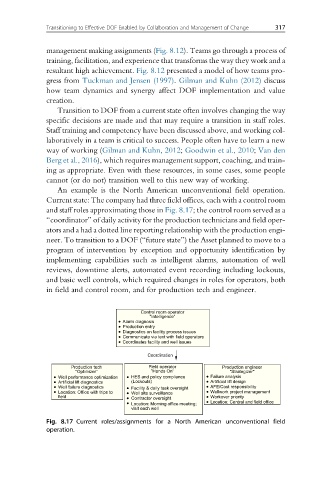
                 An example is the North American unconventional field operation.
              Current state: The company had three field offices, each with a control room
              and staff roles approximating those in Fig. 8.17; the control room served as a
              “coordinator” of daily activity for the production technicians and field oper-
              ators and a had a dotted line reporting relationship with the production engi-
              neer. To transition to a DOF (“future state”) the Asset planned to move to a
              program of intervention by exception and opportunity identification by
              implementing capabilities such as intelligent alarms, automation of well
              reviews, downtime alerts, automated event recording including lockouts,
              and basic well controls, which required changes in roles for operators, both
              in field and control room, and for production tech and engineer.


                                       Control room operator
                                         "Intelligence"
                                  Alarm diagnosis
                                  Production entry
                                  Diagnostics on facility process issues
                                  Communicate via text with field operators
                                  Coordinates facility and well issues
                                         Coordination
                    Production tech      Field operator      Production engineer
                     "Optimizer"          "Hands On"           "Strategizer"
                 Well performance optimization  HES and policy compliance  Failure analysis
                 Artificial lift diagnostics  (Lockouts)  Artificial lift design
                 Well failure diagnostics  Facility & daily task oversight  AFE/Cost responsibility
                 Location: Office with trips to  Well site surveillance  Wellwork project management
                 field                                    Workover priority
                                    Contractor oversight
                                    Location: Morning office meeting;  Location: Central and field office
                                    visit each well
              Fig. 8.17 Current roles/assignments for a North American unconventional field
              operation.

