


Page 305 - Introduction to Mineral Exploration
P. 305
288   M.K.G. WHATELEY & W.L. BARRETT


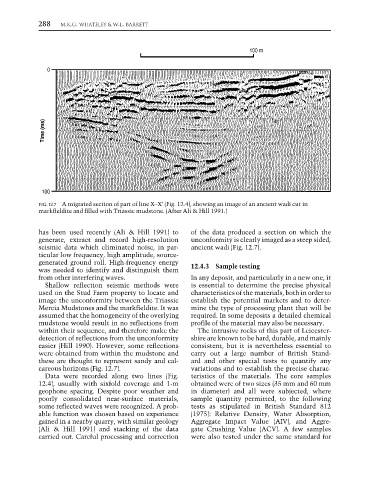
                  FIG. 12.7  A migrated section of part of line X–X′ (Fig. 12.4), showing an image of an ancient wadi cut in
                  markfieldite and filled with Triassic mudstone. (After Ali & Hill 1991.)


                  has been used recently (Ali & Hill 1991) to  of the data produced a section on which the
                  generate, extract and record high-resolution  unconformity is clearly imaged as a steep sided,
                  seismic data which eliminated noise, in par-  ancient wadi (Fig. 12.7).
                  ticular low frequency, high amplitude, source-
                  generated ground roll. High-frequency energy
                  was needed to identify and distinguish them  12.4.3  Sample testing
                  from other interfering waves.               In any deposit, and particularly in a new one, it
                    Shallow reflection seismic methods were    is essential to determine the precise physical
                  used on the Stud Farm property to locate and  characteristics of the materials, both in order to
                  image the unconformity between the Triassic  establish the potential markets and to deter-
                  Mercia Mudstones and the markfieldite. It was  mine the type of processing plant that will be
                  assumed that the homogeneity of the overlying  required. In some deposits a detailed chemical
                  mudstone would result in no reflections from  profile of the material may also be necessary.
                  within their sequence, and therefore make the  The intrusive rocks of this part of Leicester-
                  detection of reflections from the unconformity  shire are known to be hard, durable, and mainly
                  easier (Hill 1990). However, some reflections  consistent, but it is nevertheless essential to
                  were obtained from within the mudstone and  carry out a large number of British Stand-
                  these are thought to represent sandy and cal-  ard and other special tests to quantify any
                  careous horizons (Fig. 12.7).               variations and to establish the precise charac-
                    Data were recorded along two lines (Fig.  teristics of the materials. The core samples
                  12.4), usually with sixfold coverage and 1-m  obtained were of two sizes (35 mm and 60 mm
                  geophone spacing. Despite poor weather and  in diameter) and all were subjected, where
                  poorly consolidated near-surface materials,  sample quantity permitted, to the following
                  some reflected waves were recognized. A prob-  tests as stipulated in British Standard 812
                  able function was chosen based on experience  (1975): Relative Density, Water Absorption,
                  gained in a nearby quarry, with similar geology  Aggregate Impact Value (AIV), and Aggre-
                  (Ali & Hill 1991) and stacking of the data  gate Crushing Value (ACV). A few samples
                  carried out. Careful processing and correction  were also tested under the same standard for

