


Page 372 - Sami Franssila Introduction to Microfabrication
P. 372
Yield 351


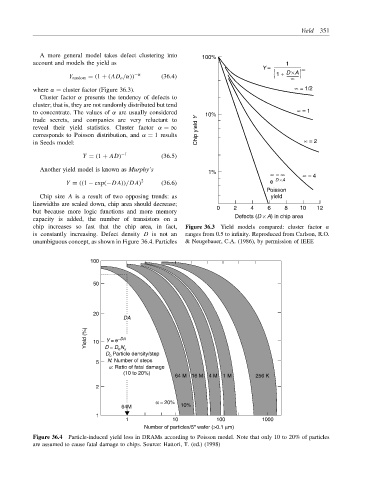
             A more general model takes defect clustering into  100%
           account and models the yield as                                          1
                                                                             Y =    D ×A  ∝
                     Y random = (1 + (AD o /α)) −α  (36.4)                       1 +  ∝

           where α = cluster factor (Figure 36.3).                                     ∝ = 1/2
             Cluster factor α presents the tendency of defects to
           cluster; that is, they are not randomly distributed but tend
           to concentrate. The values of α are usually considered  10%                 ∝ = 1
           trade secrets, and companies are very reluctant to
           reveal their yield statistics. Cluster factor α = ∞  Chip yield Y
           corresponds to Poisson distribution, and α = 1 results
           in Seeds model:                                                               ∝ = 2

                         Y = (1 + AD) −1        (36.5)
             Another yield model is known as Murphy’s        1%
                                                                                ∝ = ∞    ∝ = 4
                    Y = ((1 − exp(−DA))/DA) 2   (36.6)                         e −D ×A
                                                                              Poisson
             Chip size A is a result of two opposing trends: as                 yield
           linewidths are scaled down, chip area should decrease;  0  2   4    6    8   10   12
           but because more logic functions and more memory
           capacity is added, the number of transistors on a         Defects (D × A) in chip area
           chip increases so fast that the chip area, in fact,  Figure 36.3 Yield models compared: cluster factor α
           is constantly increasing. Defect density D is not an  ranges from 0.5 to infinity. Reproduced from Carlson, R.O.
           unambiguous concept, as shown in Figure 36.4. Particles  & Neugebauer, C.A. (1986), by permission of IEEE


                           100


                            50


                            20
                                     DA
                          Yield (%)  10  Y = e −DA


                               D = D o N a
                                D o Particle density/step
                             5  N: Number of steps
                                 a: Ratio of fatal damage
                                     (10 to 20%)
                                                    64 M 16 M  4 M  1 M    256 K
                             2
                                              α = 20%
                                    64M              10%
                             1
                                      1            10           100          1000
                                           Number of particles/5" wafer (>0.1 µm)
           Figure 36.4 Particle-induced yield loss in DRAMs according to Poisson model. Note that only 10 to 20% of particles
           are assumed to cause fatal damage to chips. Source: Hattori, T. (ed.) (1998)

