


Page 377 - Sami Franssila Introduction to Microfabrication
P. 377
356 Introduction to Microfabrication


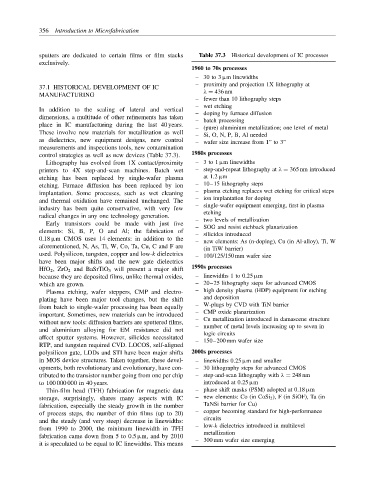
            sputters are dedicated to certain films or film stacks  Table 37.3 Historical development of IC processes
            exclusively.
                                                         1960 to 70s processes
                                                          – 30 to 3 µm linewidths
                                                          – proximity and projection 1X lithography at
            37.1 HISTORICAL DEVELOPMENT OF IC
            MANUFACTURING                                   λ = 436 nm
                                                          – fewer than 10 lithography steps
                                                          – wet etching
            In addition to the scaling of lateral and vertical  – doping by furnace diffusion
            dimensions, a multitude of other refinements has taken  – batch processing
            place in IC manufacturing during the last 40 years.  – (pure) aluminium metallization; one level of metal
            These involve new materials for metallization as well  – Si, O, N, P, B, Al needed
            as dielectrics, new equipment designs, new control  – wafer size increase from 1” to 3”
            measurements and inspections tools, new contamination
            control strategies as well as new devices (Table 37.3).  1980s processes
              Lithography has evolved from 1X contact/proximity  – 3 to 1 µm linewidths
            printers to 4X step-and-scan machines. Batch wet  – step-and-repeat lithography at λ = 365 nm introduced
            etching has been replaced by single-wafer plasma  at 1.2 µm
            etching. Furnace diffusion has been replaced by ion  – 10–15 lithography steps
            implantation. Some processes, such as wet cleaning  – plasma etching replaces wet etching for critical steps
            and thermal oxidation have remained unchanged. The  – ion implantation for doping
            industry has been quite conservative, with very few  – single-wafer equipment emerging, first in plasma
            radical changes in any one technology generation.  etching
              Early transistors could be made with just five  – two levels of metallization
                                                          – SOG and resist etchback planarization
            elements: Si, B, P, O and Al; the fabrication of  – silicides introduced
            0.18 µm CMOS uses 14 elements: in addition to the
                                                          – new elements: As (n-doping), Cu (in Al-alloy), Ti, W
            aforementioned, N, As, Ti, W, Co, Ta, Cu, C and F are  (in TiW barrier)
            used. Polysilicon, tungsten, copper and low-k dielectrics  – 100/125/150 mm wafer size
            have been major shifts and the new gate dielectrics
            HfO 2 , ZrO 2 and BaSrTiO 3 will present a major shift  1990s processes
            because they are deposited films, unlike thermal oxides,  – linewidths 1 to 0.25 µm
            which are grown.                              – 20–25 lithography steps for advanced CMOS
              Plasma etching, wafer steppers, CMP and electro-  – high density plasma (HDP) equipment for etching
            plating have been major tool changes, but the shift  and deposition
                                                          – W-plugs by CVD with TiN barrier
            from batch to single-wafer processing has been equally
                                                          – CMP oxide planarization
            important. Sometimes, new materials can be introduced
                                                          – Cu metallization introduced in damascene structure
            without new tools: diffusion barriers are sputtered films,
                                                          – number of metal levels increasing up to seven in
            and aluminium alloying for EM resistance did not
                                                            logic circuits
            affect sputter systems. However, silicides necessitated
                                                          – 150–200 mm wafer size
            RTP, and tungsten required CVD. LOCOS, self-aligned
            polysilicon gate, LDDs and STI have been major shifts  2000s processes
            in MOS device structures. Taken together, these devel-  – linewidths 0.25 µm and smaller
            opments, both revolutionary and evolutionary, have con-  – 30 lithography steps for advanced CMOS
            tributed to the transistor number going from one per chip  – step-and-scan lithography with λ = 248 nm
            to 100 000 000 in 40 years.                     introduced at 0.25 µm
              Thin-film head (TFH) fabrication for magnetic data  – phase shift masks (PSM) adopted at 0.18 µm
            storage, surprisingly, shares many aspects with IC  – new elements: Co (in CoSi 2 ), F (in SiOF), Ta (in
            fabrication, especially the steady growth in the number  TaNSi barrier for Cu)
            of process steps, the number of thin films (up to 20)  – copper becoming standard for high-performance
            and the steady (and very steep) decrease in linewidths:  circuits
            from 1990 to 2000, the minimum linewidth in TFH  – low-k dielectrics introduced in multilevel
                                                            metallization
            fabrication came down from 5 to 0.5 µm, and by 2010  – 300 mm wafer size emerging
            it is speculated to be equal to IC linewidths. This means

