


Page 381 - Sami Franssila Introduction to Microfabrication
P. 381
360 Introduction to Microfabrication


                                                         3. Maskless lithography by direct writing is expen-
                  50           Total                       sive because it is very slow, but there is no pho-
                                        D ≈ 0.3/cm 2
                                          o
                  40                       (1992)          tomask cost. Assuming identical capital investment
                                                           ($6 million) and running costs ($0.5 million/year) for
              Cost  ($/cm 2 )  30                          both optical and direct write lithography systems (a
                                                           very crude approximation), and 100 WPH for optical
                  20       1.3 cm 2                        and 2 WPH for DW on 300 mm wafers, what would
                                                           be the number of wafers at which DW becomes com-
                                         Proc.
                  10                                       petitive with optical lithography for 0.1 µm CMOS
                      Waste                 Package        if the mask set cost is assumed to be $500 000?
                   0                                     4. If photoresist stripping in a 30 000 WPM fab is 50/50
                    0.1     1       10     100    1000     between wet tanks and single-wafer plasma strippers,
                                        2
                                 Area (cm )                how many wet benches and plasma strip tools are
                                    (a)                    needed? Make assumptions about throughputs based
                                                           on similar processes/tools.
                                                         5. If a 30 000 WPM fab has four gate oxidation tubes,
                 50                                        what is their average utilization?
                                                                                   15
                                            Total        6. Under the conditions of 10 cm −2  phosphorus
                 40                                        implant dose, 200 mm wafer size, PH 3 bottle vol-
              Cost  ($/cm 2 )  30  D o ≈ 0.3 cm −2  D o ≈ 0.01 cm −2  ume 3 L (STP), how many wafers can be implanted?
                                                           If ion current is 1 mA, what is the interval for bot-
                          (1992)
                                                           tle changing?
                 20                  (2010)              7. If a 2 cm chip has 1000 output pins, what would be
                                                                  2
                                     13 cm 2
                                                Proc.      the pin pitch at the chip periphery if an arrangement
                 10                                        such as the one in Figure 37.1 was employed?
                     Waste                    Package    8. How many 30 000 WPM fabs are there in the world?
                  0
                   0.1     1      10     100    1000
                                        2
                                 Area (cm )              REFERENCES AND RELATED READINGS
                                    (b)                  Diebold, A.C.: Materials and failure analysis methods and
                                                          systems used in the development and manufacture of silicon
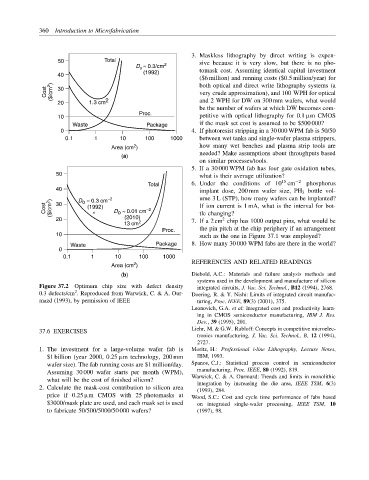
            Figure 37.2 Optimum chip size with defect density  integrated circuits, J. Vac. Sci. Technol., B12 (1994), 2768.
                       2
            0.3 defects/cm . Reproduced from Warwick, C. & A. Our-  Doering, R. & Y. Nishi: Limits of integrated circuit manufac-
            mazd (1993), by permission of IEEE            turing, Proc. IEEE, 89(3) (2001), 375.
                                                         Leonovich, G.A. et al: Integrated cost and productivity learn-
                                                          ing in CMOS semiconductor manufacturing, IBM J. Res.
                                                          Dev., 39 (1995), 201.
                                                         Liehr, M. & G.W. Rubloff: Concepts in competitive microelec-
            37.6 EXERCISES
                                                          tronics manufacturing, J. Vac. Sci. Technol., B, 12 (1994),
                                                          2727.
            1. The investment for a large-volume wafer fab is  Moritz, H.: Professional i-line Lithography, Lecture Notes,
               $1 billion (year 2000, 0.25 µm technology, 200 mm  IBM, 1993.
               wafer size). The fab running costs are $1 million/day.  Spanos, C.J.: Statistical process control in semiconductor
               Assuming 30 000 wafer starts per month (WPM),  manufacturing, Proc. IEEE, 80 (1992), 819.
               what will be the cost of finished silicon?  Warwick, C. & A. Ourmazd: Trends and limits in monolithic
                                                          integration by increasing the die area, IEEE TSM, 6(3)
            2. Calculate the mask-cost contribution to silicon area
                                                          (1993), 284.
               price if 0.25 µm CMOS with 25 photomasks at  Wood, S.C.: Cost and cycle time performance of fabs based
               $3000/mask plate are used, and each mask set is used  on integrated single-wafer processing, IEEE TSM, 10
               to fabricate 50/500/5000/50000 wafers?     (1997), 98.

