


Page 155 - Know and Understand Centrifugal Pumps
P. 155
Know and Understand Centrifugal Pumps


         2.  You  may see the same evidence all around the circumference of the
            close tolerance  rotary elements,  with  gouge  or wear  spots on the
            stationary elements at about 240" from the pump cutwater.

                These marks are caused or induced by  operations or by design.
                This evidence is  revealed when  operating  the  pump too far to
                the  right  of  the  BEP  on  its  curve.  Perhaps  the  pump  is
                inadequate and doesn't  meet the flow and head requirements of
                the system. It could also be that there is  a loss of resistance in
                the discharge piping. A big hole  in  the  discharge  piping  could
                present the same evidence.
                If you  must  live with  this condition,  you  need  to increase the
                diameter of the shaft to improve the L/D  factor and deflection
                resistance.
         3.  If you  see  the  same evidence,  gouge  and wear  marks  around  the
            circumference of close tolerance rotary elements, and spots or arcs
            on the close tolerance  stationary  elements at about  180" from the
            cutwater, or straight down:
                This would be a problem induced by inadequate design, caused
                by  pipe  strain  probably  in  a  high  temperature  (thermal
                expansion)  application.  The  volute  of  the  pump  and  the
                stationary  elements  are  growing  up  from  the  floor  due  to
                thermal  expansion,  against  the  rotary  elements.  You  need  to
                speak with  the  plant  engineer  and  show  him  the  evidence.  A
                possible solution is to change your ANSI  standard pump for a
                'High Temperature' or API design in this application.

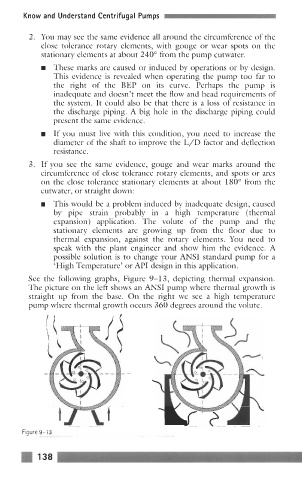
         See  the  following graphs,  Figure  9-1 3,  depicting thermal  expansion.
         The picture on the left shows an ANSI pump where thermal growth is
         straight  up  from  the  base.  On the  right  we  see  a  high  temperature
         pump where thermal growth occurs 360 degrees around the volute.

