


Page 157 - Know and Understand Centrifugal Pumps
P. 157
Know and Understand Centrifugal Pumps

          aforementioned  reasons  up  to  this  moment,  and  even  including
          vibration, damaged and misapplied bearings.
          The  problem  could  be  maintenance,  operation,  or  design,  or  a
          combination of any or all these factors. In all honesty, you should never
          see this set of evidence marks because it indicates a lack of control. Now
          because  the  mechanic  cannot  control operational problems or design
          problems,  the  first  phase  to  correct  this  situation  is  to  control  the
          mechanical  maintenance  factors,  like  alignment,  proper  bolting  and
          torque  sequences,  be  sure  shafts  are  straight  and  round,  and
          dynamically balance all rotary components. Reinstall the pump and wait
          for the  next  failure.  Once  the  maintenance  factors  are under  control,
          there  should appear a clear vision  and path  to resolve any operational
          and/or  design weaknesses.


        The sweet zone

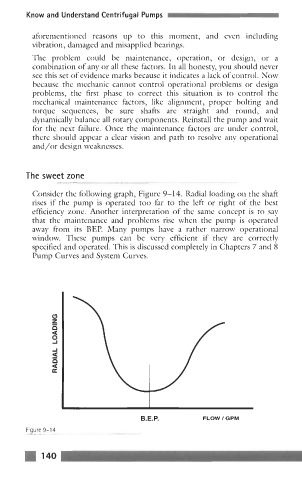
          Consider the following graph, Figure 9-14.  Radial loading on the shaft
          rises  if  the  pump  is  operated  too  far  to  the  left  or right  of the  best
          efficiency zone. Another  interpretation  of the  same concept  is  to  say
          that  the  maintenance  and problems  rise  when  the  pump  is  operated
          away  from  its  BEP.  Many  pumps  have  a  rather  narrow  operational
          window.  These  pumps  can  be  very  efficient  if  they  are  correctly
          specified and operated. This is discussed completely in Chapters 7 and 8
          Pump Curves and System Curves.


                                       B.E.P.           FLOW I GPM
        Figure 9-14
                                                               -

