


Page 103 - Low Temperature Energy Systems with Applications of Renewable Energy
P. 103
92                  Low-Temperature Energy Systems with Applications of Renewable Energy

            Thus, triple-expansion of the liquid refrigerant results in a very low fluid tempera-
         ture as it enters the evaporator, allowing heat transfer from the surroundings even at
         low ambient temperatures. Furthermore, using a 2-stage compressor with effective
         interstage cooling results in less power needed for the compressor. Both of these ef-
         fects extend the range of the heat pump and increase its COP compared to a simple
         system. There are other practical advantages such as guaranteeing that only vapor en-
         ters the compressor impeller and that only liquid enters the expansion valves [2].


         3.1.3  Combined heat pump systems
         In temperate and northern climatic zones, heat pumps of the “earth-water" (or “ground-
         to-water”) and “water-to-water" type are used to avoid the low ambient air temperature
         problem. Combined heat pump units include various energy sources such as solar en-
         ergy, heat of waste water and sewages, heat of water crystallization, ventilated air, etc.
         When using heat pumps, various low-temperature renewable energy sources are used
         to reduce capital and operating costs. However, the use of various energy sources re-
         duces the energy capacity of heat pump units by 25e30% compared to conventional
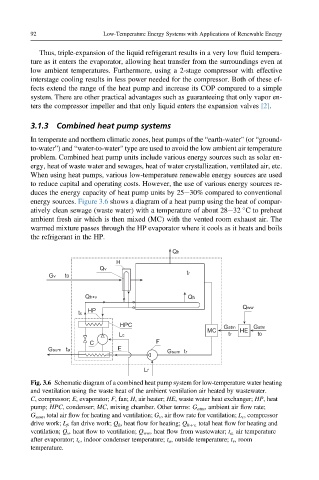
         energy sources. Figure 3.6 shows a diagram of a heat pump using the heat of compar-

         atively clean sewage (waste water) with a temperature of about 28e32 C to preheat
         ambient fresh air which is then mixed (MC) with the vented room exhaust air. The
         warmed mixture passes through the HP evaporator where it cools as it heats and boils
         the refrigerant in the HP.
                                                Qh
                                H
                            Qv
                                                   tr
              Gv   t0

                        Qh+v                        Qh
                                                                   Qww
                         HP
                      tc
                                 HPC                         Gatm    Gatm
                                                         MC       HE
                                 Lc                            tr      t0
                         C                 F
              Gsum ta            E
                                              Gsum tr
                                        Lf
         Fig. 3.6 Schematic diagram of a combined heat pump system for low-temperature water heating
         and ventilation using the waste heat of the ambient ventilation air heated by wastewater.
         C, compressor; E, evaporator; F, fan; H, air heater; HE, waste water heat exchanger; HP, heat
         pump; HPC, condenser; MC, mixing chamber. Other terms: G atm , ambient air flow rate;
         G sum , total air flow for heating and ventilation; G v , air flow rate for ventilation; L c , compressor
         drive work; L f , fan drive work; Q h , heat flow for heating; Q hþv, total heat flow for heating and
         ventilation; Q v , heat flow to ventilation; Q ww , heat flow from wastewater; t a, air temperature
         after evaporator; t c , indoor condenser temperature; t o , outside temperature; t r , room
         temperature.

