


Page 104 - Low Temperature Energy Systems with Applications of Renewable Energy
P. 104
Effective use of heat pumps for various heating applications       93

              In Fig. 3.6, an air-water heat exchanger is used for heating the ambient air before
           entering the mixing chamber (MC). Thus, after the MC, a mixture of ventilating
           and ambient air with a temperature being approximately equal to the temperature in

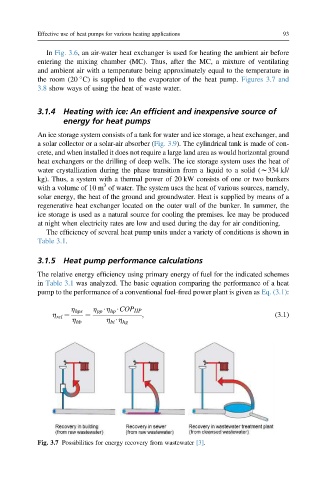
           the room (20 C) is supplied to the evaporator of the heat pump. Figures 3.7 and
           3.8 show ways of using the heat of waste water.

           3.1.4  Heating with ice: An efficient and inexpensive source of
                  energy for heat pumps
           An ice storage system consists of a tank for water and ice storage, a heat exchanger, and
           a solar collector or a solar-air absorber (Fig. 3.9). The cylindrical tank is made of con-
           crete, and when installed it does not require a large land area as would horizontal ground
           heat exchangers or the drilling of deep wells. The ice storage system uses the heat of
           water crystallization during the phase transition from a liquid to a solid (w334 kJ/
           kg). Thus, a system with a thermal power of 20 kW consists of one or two bunkers
                             3
           with a volume of 10 m of water. The system uses the heat of various sources, namely,
           solar energy, the heat of the ground and groundwater. Heat is supplied by means of a
           regenerative heat exchanger located on the outer wall of the bunker. In summer, the
           ice storage is used as a natural source for cooling the premises. Ice may be produced
           at night when electricity rates are low and used during the day for air conditioning.
              The efficiency of several heat pump units under a variety of conditions is shown in
           Table 3.1.

           3.1.5  Heat pump performance calculations

           The relative energy efficiency using primary energy of fuel for the indicated schemes
           in Table 3.1 was analyzed. The basic equation comparing the performance of a heat
           pump to the performance of a conventional fuel-fired power plant is given as Eq. (3.1):

                    h hps  h $h $COP HP
                           pp
                               hp
               h rel  ¼  ¼             ;                                   (3.1)
                    h hb      h $h hg
                               bi


           Fig. 3.7 Possibilities for energy recovery from wastewater [3].

