


Page 279 - Low Temperature Energy Systems with Applications of Renewable Energy
P. 279
Biofuels conversion: energy-saving processes and use of biogas    265

           energy sources with the greatest potential. The use of indigenous unconventional
           energy sources will significantly reduce the dependence of countries on imported en-
           ergy and negative environmental impact.
              The increase in the cost of traditional energy sources and the further man-made
           impact on the natural environment both point to increasing the use of renewable alter-
           native sources of energy. Up to 65% of renewable energy sources can be obtained from
           organic matter of agricultural origin.
                                 3
              An average of 20e25 m volume of biogas is estimated to be to obtained nowadays
                   3
                                                       3
           from 1 m of animal waste, but an amount of 30e35 m is currently needed for tech-
           nical and economic feasibility. This amount of gas can be obtained by combining an-
           imal excretions and household wastes with other raw materials that are distinguished
           by high content of dry organic mass [8e10].
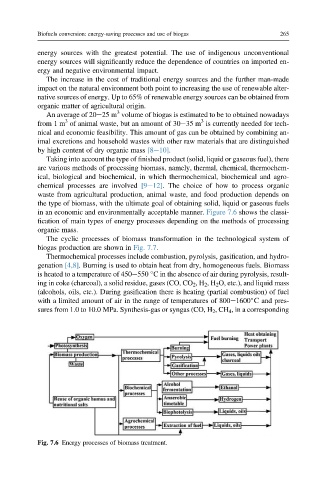
              Taking into account the type of finished product (solid, liquid or gaseous fuel), there
           are various methods of processing biomass, namely, thermal, chemical, thermochem-
           ical, biological and biochemical, in which thermochemical, biochemical and agro-
           chemical processes are involved [9e12]. The choice of how to process organic
           waste from agricultural production, animal waste, and food production depends on
           the type of biomass, with the ultimate goal of obtaining solid, liquid or gaseous fuels
           in an economic and environmentally acceptable manner. Figure 7.6 shows the classi-
           fication of main types of energy processes depending on the methods of processing
           organic mass.
              The cyclic processes of biomass transformation in the technological system of
           biogas production are shown in Fig. 7.7.
              Thermochemical processes include combustion, pyrolysis, gasification, and hydro-
           genation [4,8]. Burning is used to obtain heat from dry, homogeneous fuels. Biomass

           is heated to a temperature of 450e550 C in the absence of air during pyrolysis, result-
           ing in coke (charcoal), a solid residue, gases (CO, CO 2 ,H 2 ,H 2 O, etc.), and liquid mass
           (alcohols, oils, etc.). During gasification there is heating (partial combustion) of fuel
           with a limited amount of air in the range of temperatures of 800e1600 S and pres-

           sures from 1.0 to 10.0 MPa. Synthesis-gas or syngas (CO, H 2 ,CH 4 , in a corresponding


           Fig. 7.6 Energy processes of biomass treatment.

