


Page 282 - Low Temperature Energy Systems with Applications of Renewable Energy
P. 282
268                 Low-Temperature Energy Systems with Applications of Renewable Energy

         Table 7.1 Biogas output and methane content from various kinds of waste.

                                      Biogas output,
                                         3
          Raw material                dm /kg dry matter     Methane content, %
          Cattle humus a              200e300               50
          Pig humus a                 340e480               60e75
                    a
          Horse humus with straw      250                   56e60
          Potato tops                 420                   60
          Corn stalks                 420                   53
          Wheat straw                 342                   58
          Sunflower husk               300                   60
          Silage                      250                   84
          Fresh grass                 360                   52
          Beet                        430                   84
          Carrot Waste                250                   60
          Wood sawdust                220                   51
          Solid sewage sludge         570                   70
          Fecal sediment              250e310               60
          Household waste and garbage  600                  50
         a
          Black, broken-down, stable organic matter in soil.
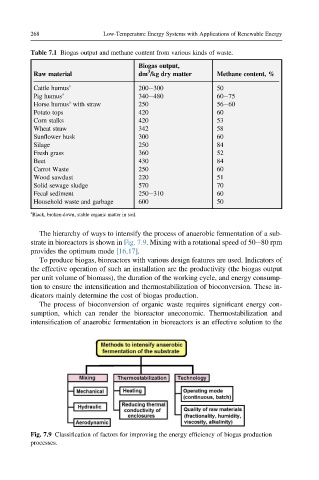
            The hierarchy of ways to intensify the process of anaerobic fermentation of a sub-
         strate in bioreactors is shown in Fig. 7.9. Mixing with a rotational speed of 50e80 rpm
         provides the optimum mode [16,17].
            To produce biogas, bioreactors with various design features are used. Indicators of
         the effective operation of such an installation are the productivity (the biogas output
         per unit volume of biomass), the duration of the working cycle, and energy consump-
         tion to ensure the intensification and thermostabilization of bioconversion. These in-
         dicators mainly determine the cost of biogas production.
            The process of bioconversion of organic waste requires significant energy con-
         sumption, which can render the bioreactor uneconomic. Thermostabilization and
         intensification of anaerobic fermentation in bioreactors is an effective solution to the


         Fig. 7.9 Classification of factors for improving the energy efficiency of biogas production
         processes.

