


Page 285 - Low Temperature Energy Systems with Applications of Renewable Energy
P. 285
Biofuels conversion: energy-saving processes and use of biogas    271

              Mesophilic fermentation, as confirmed by research and operational practice of in-
           stallations, procedes in the most intensive way in the temperature range of

           32e42 S. At the same time, the most active “working” bacteria are methanogenic
           ones with the maximum formation of biogas. However, the deviation from the optimal

           temperature interval by  5 C leads to a decrease in the biogas output by 2e2.5 times,
           which indicates the sensitivity of bacteria to the temperature of the environment and
           requires the implementation of precise controllers to maintain it. Heating and maintain-
           ing a stable temperature of fermentation is usually carried out by pumping heated water
           through special heat exchangers mounted in a bioreactor. Hot water is produced in a
           boiler unit, using part of the biogas for its operation.
              Thermophilic fermentation offers the opportunity to obtain the maximum amount of
           biogas in a short period of time. The fermentation intensity is two times higher, and the
           residence time in the bioreactor is 50% shorter compared with mesophilic fermenta-
           tion. However maintaining a relatively high temperature requires significant energy
           consumption.
              From Fig. 7.11 it is clear that in addition to the properties and characteristics of the
           organic mass used for the biogas production process, physical factors in the bioreactor
           influence the operation, in particular, the temperature of fermentation and the hydraulic
           regime. These factors are important in improving the equipment for biogas production.
           By using the equipment with optimal parameters of heating and mixing the substrate in
           a bioreactor, it is possible to achieve an energy-efficient biogas production system.
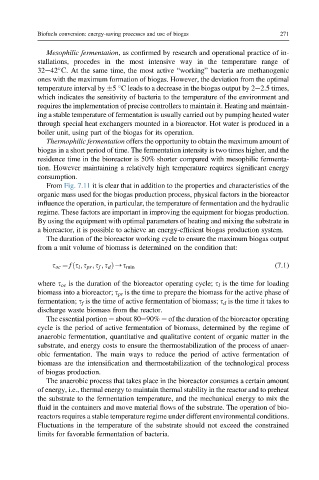
              The duration of the bioreactor working cycle to ensure the maximum biogas output
           from a unit volume of biomass is determined on the condition that:

                                                                           (7.1)
               s oc ¼ f ðs l ; s pr ; s f ; s d Þ/s min
           where s oc is the duration of the bioreactor operating cycle; s l is the time for loading
           biomass into a bioreactor; s pr is the time to prepare the biomass for the active phase of
           fermentation; s f is the time of active fermentation of biomass; s d is the time it takes to
           discharge waste biomass from the reactor.
              The essential portion e about 80e90% e of the duration of the bioreactor operating
           cycle is the period of active fermentation of biomass, determined by the regime of
           anaerobic fermentation, quantitative and qualitative content of organic matter in the
           substrate, and energy costs to ensure the thermostabilization of the process of anaer-
           obic fermentation. The main ways to reduce the period of active fermentation of
           biomass are the intensification and thermostabilization of the technological process
           of biogas production.
              The anaerobic process that takes place in the bioreactor consumes a certain amount
           of energy, i.e., thermal energy to maintain thermal stability in the reactor and to preheat
           the substrate to the fermentation temperature, and the mechanical energy to mix the
           fluid in the containers and move material flows of the substrate. The operation of bio-
           reactors requires a stable temperature regime under different environmental conditions.
           Fluctuations in the temperature of the substrate should not exceed the constrained
           limits for favorable fermentation of bacteria.

