


Page 284 - Low Temperature Energy Systems with Applications of Renewable Energy
P. 284
270                 Low-Temperature Energy Systems with Applications of Renewable Energy

            To achieve high efficiency of bioreactors and obtain the maximum amount of
         biogas per unit volume of biomass, it is necessary to create optimal technical param-
         eters in the bioreactor. The intensity of the fermentation process and, consequently, the
         formation of biogas is influenced by four groups of factors, namely, biological, phys-
         ical, chemical, and organizational-technological.
            The process of anaerobic fermentation in the bioreactor is influenced by several fac-
         tors, the improvement of which leads to an increase in efficiency of use of raw mate-
         rials for the generation of biogas and a decrease in cost of the entire process. Factors for
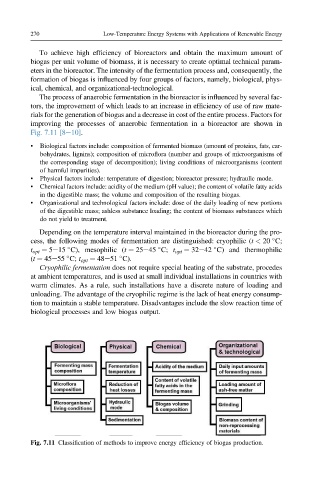
         improving the processes of anaerobic fermentation in a bioreactor are shown in
         Fig. 7.11 [8e10].
         •  Biological factors include: composition of fermented biomass (amount of proteins, fats, car-
            bohydrates, lignins); composition of microflora (number and groups of microorganisms of
            the corresponding stage of decomposition); living conditions of microorganisms (content
            of harmful impurities).
         •  Physical factors include: temperature of digestion; bioreactor pressure; hydraulic mode.
         •  Chemical factors include: acidity of the medium (pH value); the content of volatile fatty acids
            in the digestible mass; the volume and composition of the resulting biogas.
         •  Organizational and technological factors include: dose of the daily loading of new portions
            of the digestible mass; ashless substance loading; the content of biomass substances which
            do not yield to treatment.

            Depending on the temperature interval maintained in the bioreactor during the pro-

         cess, the following modes of fermentation are distinguished: cryophilic (t < 20 C;


         t opt ¼ 5e15 C), mesophilic (t ¼ 25e45 C; t opt ¼ 32e42 C) and thermophilic


         (t ¼ 45e55 C; t opt ¼ 48e51 C).
            Cryophilic fermentation does not require special heating of the substrate, procedes
         at ambient temperatures, and is used at small individual installations in countries with
         warm climates. As a rule, such installations have a discrete nature of loading and
         unloading. The advantage of the cryophilic regime is the lack of heat energy consump-
         tion to maintain a stable temperature. Disadvantages include the slow reaction time of
         biological processes and low biogas output.


         Fig. 7.11 Classification of methods to improve energy efficiency of biogas production.

