


Page 286 - Machine Learning for Subsurface Characterization
P. 286
248 Machine learning for subsurface characterization


               will increase with the increase in number of source-receiver pairs. In the real
               world, the number of source-receiver pairs can be five times or higher as
               compared with that implemented in this study.
            c. As a proof of concept, each receiver detects only the first arrival (i.e., wave-
               front travel time) of compressional wave, and the characterization is accom-
               plished only with compressional travel-time data, which are very limited
               information related to the wave propagation through a fractured material.
               Characterization performance will increase with the use of shear wavefront
               travel times or full compressional/shear waveforms.
            d. Feature importance is performed using feature permutation importance to
               identify the optimal placement of receivers/sensors for accomplishing the
               desired static characterization of discontinuities by processing the multi-
               point measurements of compressional wavefront travel times.
            e. The proposed method can approximate certain statistical parameters of the
               system of discontinuities, like dominant orientation and intensity of distri-
               bution, with simple source-receiver configurations.


            3 Fast-marching method (FMM)
            3.1 Introduction

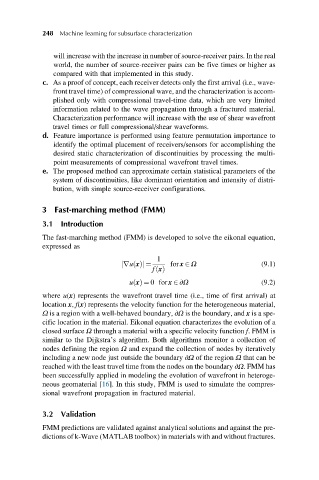
            The fast-marching method (FMM) is developed to solve the eikonal equation,
            expressed as
                                           1
                                  j ru xðÞj ¼  for x 2 Ω                (9.1)
                                          f xðÞ
                                    u xðÞ ¼ 0 forx 2 ∂Ω                 (9.2)
            where u(x) represents the wavefront travel time (i.e., time of first arrival) at
            location x, f(x) represents the velocity function for the heterogeneous material,
            Ω is a region with a well-behaved boundary, ∂Ω is the boundary, and x is a spe-
            cific location in the material. Eikonal equation characterizes the evolution of a
            closed surface Ω through a material with a specific velocity function f. FMM is
            similar to the Dijkstra’s algorithm. Both algorithms monitor a collection of
            nodes defining the region Ω and expand the collection of nodes by iteratively
            including a new node just outside the boundary ∂Ω of the region Ω that can be
            reached with the least travel time from the nodes on the boundary ∂Ω. FMM has
            been successfully applied in modeling the evolution of wavefront in heteroge-
            neous geomaterial [16]. In this study, FMM is used to simulate the compres-
            sional wavefront propagation in fractured material.

            3.2 Validation

            FMM predictions are validated against analytical solutions and against the pre-
            dictions of k-Wave (MATLAB toolbox) in materials with and without fractures.

