


Page 287 - Machine Learning for Subsurface Characterization
P. 287
Classification of sonic wave Chapter  9 249


             An extensive validation was performed to ensure the reliability of the simulated
             dataset generated using FMM for purposes of developing/evaluating data-
             driven models for the noninvasive static characterization of mechanical
             discontinuities.

             3.2.1 Numerical model of homogeneous material at various
             spatial discretization
             Discretization governs the accuracy of the FMM and k-Wave simulations [17].
             Spatial discretization of a numerical model is defined by the number of grids (or
             grid size) implemented in the model. With the increase in the number of girds,
             the accuracy and computational time of the simulation of wavefront travel time
             will increase till a certain optimal number of grids. Compressional velocity of
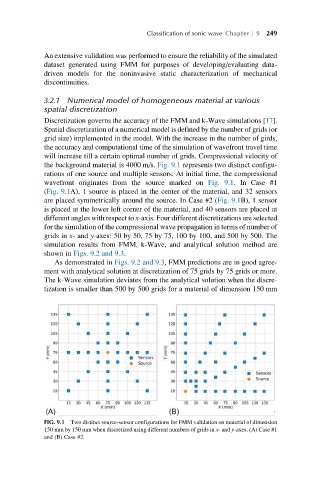
             the background material is 4000 m/s. Fig. 9.1 represents two distinct configu-
             rations of one source and multiple sensors. At initial time, the compressional
             wavefront originates from the source marked on Fig. 9.1. In Case #1
             (Fig. 9.1A), 1 source is placed in the center of the material, and 32 sensors
             are placed symmetrically around the source. In Case #2 (Fig. 9.1B), 1 sensor
             is placed at the lower left corner of the material, and 40 sensors are placed at
             different angles with respect to x-axis. Four different discretizations are selected
             for the simulation of the compressional wave propagation in terms of number of
             grids in x- and y-axes: 50 by 50, 75 by 75, 100 by 100, and 500 by 500. The
             simulation results from FMM, k-Wave, and analytical solution method are
             shown in Figs. 9.2 and 9.3.
                As demonstrated in Figs. 9.2 and 9.3, FMM predictions are in good agree-
             ment with analytical solution at discretization of 75 grids by 75 grids or more.
             The k-Wave simulation deviates from the analytical solution when the discre-
             tization is smaller than 500 by 500 grids for a material of dimension 150 mm


             FIG. 9.1 Two distinct source-sensor configurations for FMM validation on material of dimension
             150 mm by 150 mm when discretized using different numbers of grids in x- and y-axes. (A) Case #1
             and (B) Case #2.

