


Page 292 - Machine Learning for Subsurface Characterization
P. 292
254 Machine learning for subsurface characterization


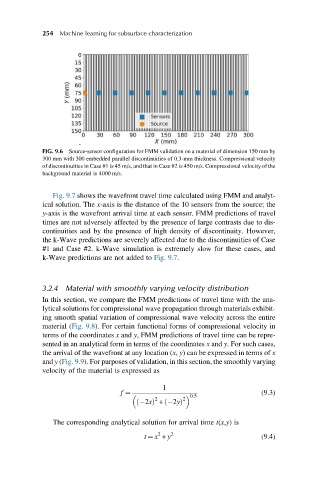
            FIG. 9.6 Source-sensor configuration for FMM validation on a material of dimension 150 mm by
            300 mm with 300 embedded parallel discontinuities of 0.3-mm thickness. Compressional velocity
            of discontinuities in Case #1 is 45 m/s, and that in Case #2 is 450 m/s. Compressional velocity of the
            background material is 4000 m/s.

               Fig. 9.7 shows the wavefront travel time calculated using FMM and analyt-
            ical solution. The x-axis is the distance of the 10 sensors from the source; the
            y-axis is the wavefront arrival time at each sensor. FMM predictions of travel
            times are not adversely affected by the presence of large contrasts due to dis-
            continuities and by the presence of high density of discontinuity. However,
            the k-Wave predictions are severely affected due to the discontinuities of Case
            #1 and Case #2. k-Wave simulation is extremely slow for these cases, and
            k-Wave predictions are not added to Fig. 9.7.


            3.2.4 Material with smoothly varying velocity distribution
            In this section, we compare the FMM predictions of travel time with the ana-
            lytical solutions for compressional wave propagation through materials exhibit-
            ing smooth spatial variation of compressional wave velocity across the entire
            material (Fig. 9.8). For certain functional forms of compressional velocity in
            terms of the coordinates x and y, FMM predictions of travel time can be repre-
            sented in an analytical form in terms of the coordinates x and y. For such cases,
            the arrival of the wavefront at any location (x, y) can be expressed in terms of x
            and y (Fig. 9.9). For purposes of validation, in this section, the smoothly varying
            velocity of the material is expressed as

                                             1
                                                                        (9.3)
                                                     0:5
                                  f ¼
                                           2      2
                                      ð  2xÞ +  2yð  Þ
               The corresponding analytical solution for arrival time t(x,y)is
                                            2
                                        t ¼ x + y 2                     (9.4)

