


Page 294 - Machine Learning for Subsurface Characterization
P. 294
256 Machine learning for subsurface characterization


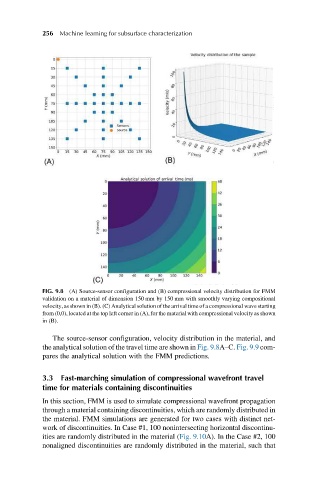
            FIG. 9.8 (A) Source-sensor configuration and (B) compressional velocity distribution for FMM
            validation on a material of dimension 150 mm by 150 mm with smoothly varying compositional
            velocity, as shown in (B). (C) Analytical solution of the arrival time of a compressional wave starting
            from (0,0), located at the top left corner in (A), for the material with compressional velocity as shown
            in (B).

               The source-sensor configuration, velocity distribution in the material, and
            the analytical solution of the travel time are shown in Fig. 9.8A–C. Fig. 9.9 com-
            pares the analytical solution with the FMM predictions.

            3.3 Fast-marching simulation of compressional wavefront travel
            time for materials containing discontinuities
            In this section, FMM is used to simulate compressional wavefront propagation
            through a material containing discontinuities, which are randomly distributed in
            the material. FMM simulations are generated for two cases with distinct net-
            work of discontinuities. In Case #1, 100 nonintersecting horizontal discontinu-
            ities are randomly distributed in the material (Fig. 9.10A). In the Case #2, 100
            nonaligned discontinuities are randomly distributed in the material, such that

