


Page 297 - Machine Learning for Subsurface Characterization
P. 297
Classification of sonic wave Chapter  9 259


             materials with and without discontinuities indicate the velocity anisotropy of
             the material containing discontinuities.


             4  Methodology for developing data-driven model for
             the noninvasive characterization of static mechanical
             discontinuities in material

             We perform three major tasks in chronological order: Step 1 create thousands of
             numerical models (realizations) of material containing various network of static
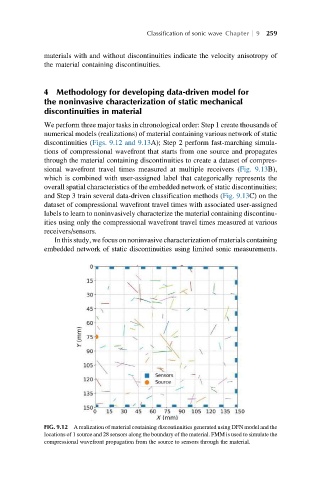
             discontinuities (Figs. 9.12 and 9.13A); Step 2 perform fast-marching simula-
             tions of compressional wavefront that starts from one source and propagates
             through the material containing discontinuities to create a dataset of compres-
             sional wavefront travel times measured at multiple receivers (Fig. 9.13B),
             which is combined with user-assigned label that categorically represents the
             overall spatial characteristics of the embedded network of static discontinuities;
             and Step 3 train several data-driven classification methods (Fig. 9.13C) on the
             dataset of compressional wavefront travel times with associated user-assigned
             labels to learn to noninvasively characterize the material containing discontinu-
             ities using only the compressional wavefront travel times measured at various
             receivers/sensors.
                In this study, we focus on noninvasive characterization of materials containing
             embedded network of static discontinuities using limited sonic measurements.


             FIG. 9.12 A realization of material containing discontinuities generated using DFN model and the
             locations of 1 source and 28 sensors along the boundary of the material. FMM is used to simulate the
             compressional wavefront propagation from the source to sensors through the material.

