


Page 300 - Machine Learning for Subsurface Characterization
P. 300
262 Machine learning for subsurface characterization


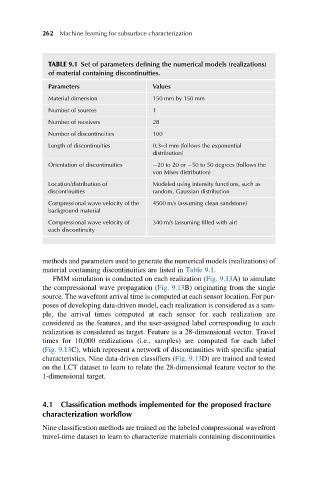
              TABLE 9.1 Set of parameters defining the numerical models (realizations)
              of material containing discontinuities.
              Parameters                  Values
              Material dimension          150 mm by 150 mm
              Number of sources           1
              Number of receivers         28
              Number of discontinuities   100
              Length of discontinuities   0.3–3 mm (follows the exponential
                                          distribution)
              Orientation of discontinuities   20 to 20 or  50 to 50 degrees (follows the
                                          von Mises distribution)
              Location/distribution of    Modeled using intensity functions, such as
              discontinuities             random, Gaussian distribution
              Compressional wave velocity of the  4500 m/s (assuming clean sandstone)
              background material
              Compressional wave velocity of  340 m/s (assuming filled with air)
              each discontinuity


            methods and parameters used to generate the numerical models (realizations) of
            material containing discontinuities are listed in Table 9.1.
               FMM simulation is conducted on each realization (Fig. 9.13A) to simulate
            the compressional wave propagation (Fig. 9.13B) originating from the single
            source. The wavefront arrival time is computed at each sensor location. For pur-
            poses of developing data-driven model, each realization is considered as a sam-
            ple, the arrival times computed at each sensor for each realization are
            considered as the features, and the user-assigned label corresponding to each
            realization is considered as target. Feature is a 28-dimensional vector. Travel
            times for 10,000 realizations (i.e., samples) are computed for each label
            (Fig. 9.13C), which represent a network of discontinuities with specific spatial
            characteristics. Nine data-driven classifiers (Fig. 9.13D) are trained and tested
            on the LCT dataset to learn to relate the 28-dimensional feature vector to the
            1-dimensional target.


            4.1 Classification methods implemented for the proposed fracture
            characterization workflow

            Nine classification methods are trained on the labeled compressional wavefront
            travel-time dataset to learn to characterize materials containing discontinuities

