


Page 500 - Marine Structural Design
P. 500
476                                                   Part IV Siructural Reliability


                 based on practical engineering judgment should be applied to the calibrated safety factor. The
                 existing  experience with  use  of  safety  factors  for  the  specified tubular joints  should be
                 considered in the judgment.


                 26.6  Numerical Example for Hull Girder Collapse of F’PSOs
                 With  a  reference to  Part  11  Chapter  13 and  Part  IV Chapter 25,  this  Section presents  a
                 reliability-based calibration of  hull  girder collapse for FPSO(Sun and  Bai,  2001).  As  an
                 illustration, the bending moment criteria may be expressed as
                                                                                     (26.23)
                      Y,M,  + YlVV,Mw  * 4UMU
                 where 5, yw and 4 are partial safety factors.
                 The  selection  of  target  reliability  levels  is  a  difficult  task  and  should be  based  on  the
                 consequences of failure, reliability formulation, and accessibility to inspection and possibility
                 of repair.
                 There are three methods that have been applied (Mansour, 1997):
                 (1)  Agreeing  upon  a  “reasonable”  value  in  the  case  of  novel  structures  without  prior
                 experience;
                 (2) Calibrating reliability level implied in currently used design codes (commonly used  for
                 code revision);
                  (3) Cost benefit analysis. Target reliability is chosen to minimize total expected costs over the
                  service life  of  the  structure. This method  is preferred  but  is  impractical due to  the  data
                 requirements of the method.
                  Mansour (1997) reviewed the sources of information on target reliabilities and suggested that
                  the reliability index for collapse strength of commercial ships be set at 3.5. Guedes Soares et a1
                  (1996), suggested that the tentative reliability indices against hull girder collapse are set at 3.7
                  for the “as built” state and  3.0  for the lower limit of corroded hulls. This is based on their
                  investigation of worldwide causalities and structural safety level implicitly built-in to present
                  ship design practice. The corroded state was defined as such that the section modulus is 90%
                 of the original (“new-built”). Two methods can be used to evaluate the partial safety factors:
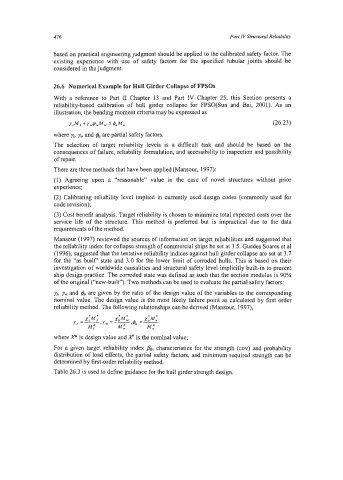
                  E,  yw and 4 are given by the ratio of the design value of the variables to the corresponding
                  nominal value. The design value is the most likely failure point as calculated by first order
                  reliability method. The following relationships can be derived (Mansour, 1997),


                  where x* is design value and X“ is the nominal value;
                  For a given target reliability index PO, characteristics for the strength (cov) and probability
                  distribution of load effects, the partial safety factors, and minimum required strength can be
                  determined by first-order reliability method.
                  Table 26.3 is used to define guidance for the hull girder strength design.

