


Page 264 - Marks Calculation for Machine Design
P. 264
P1: Shibu
                          January 4, 2005
                                      14:56
        Brown.cls
                 Brown˙C06
                                           STRENGTH OF MACHINES
                  246
                  where again the factors-of-safety are smaller than that obtained with the distortion-energy
                  theory. This is what is meant by being more conservative, or more restrictive.
                    The fact that three of the four combinations in Example 1 resulted in unsafe designs,
                  and the fourth was literally borderline, indicates that a stronger material should be used for
                  these machine elements. For example, the yield stress (S y ) could be doubled by choosing
                  cast iron, or tripled by choosing a structural steel like ASTM-A36.
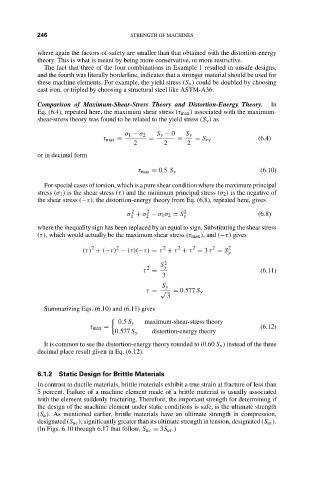
                  Comparison of Maximum-Shear-Stress Theory and Distortion-Energy Theory.  In
                  Eq. (6.4), repeated here, the maximum shear stress (τ max ) associated with the maximum-
                  shear-stress theory was found to be related to the yield stress (S y ) as
                                          σ 1 − σ 2  S y − 0  S y
                                    τ max =     =       =    = S sy           (6.4)
                                            2        2     2
                  or in decimal form
                                             τ max = 0.5 S y                   (6.10)
                    For special cases of torsion, which is a pure shear condition where the maximum principal
                  stress (σ 1 ) is the shear stress (τ) and the minimum principal stress (σ 2 ) is the negative of
                  the shear stress (−τ), the distortion-energy theory from Eq. (6.8), repeated here, gives
                                            2   2         2
                                           σ + σ − σ 1 σ 2 = S                (6.8)
                                           1    2         y
                  where the inequality sign has been replaced by an equal to sign. Substituting the shear stress
                  (τ), which would actually be the maximum shear stress (τ max ), and (−τ) gives
                                 2      2           2   2   2     2   2
                               (τ) + (−τ) − (τ)(−τ) = τ + τ + τ = 3 τ = S y
                                                    S  2
                                                2    y
                                               τ =                             (6.11)
                                                    3
                                                    S y
                                                τ = √  = 0.577 S y
                                                     3
                    Summarizing Eqs. (6.10) and (6.11) gives

                                        0.5 S y  maximum-shear-stress theory
                                τ max =                                        (6.12)
                                       0.577 S y  distortion-energy theory
                    It is common to see the distortion-energy theory rounded to (0.60 S y ) instead of the three
                  decimal place result given in Eq. (6.12).

                  6.1.2 Static Design for Brittle Materials
                  In contrast to ductile materials, brittle materials exhibit a true strain at fracture of less than
                  5 percent. Failure of a machine element made of a brittle material is usually associated
                  with the element suddenly fracturing. Therefore, the important strength for determining if
                  the design of the machine element under static conditions is safe, is the ultimate strength
                  (S u ). As mentioned earlier, brittle materials have an ultimate strength in compression,
                  designated (S uc ), significantly greater than its ultimate strength in tension, designated (S ut ).
                  (In Figs. 6.10 through 6.17 that follow, S uc = 3S ut .)

